Come See our New Website

Showing posts with label Publishing. Show all posts

Tuesday, December 2, 2014

The Real Reason Bookstores Are Going Extinct

Fifteen years ago the musty smell of books and the sounds of vinyl and plastic CDs were the dominating and common elements of a books and media store.

These days, iPads and Kindles go anywhere we have time to read, including sometimes the doctor’s office and even the bathroom. Electronic devices hold hundreds of precious books with fast and easy access. Why waste time, energy and gas to go to an actual library and buy something that will occupy space at home?

Some books are the exception, worth the gas and time to have on a bookshelf. However the allure of printed-books is not as strong as it used to be. When Stephen King, big horror fiction writer, was asked his if fiction books would remain in the future, as they currently are, his answer was “Absolutely they will not.”

Other writers and readers are addicted to the texture, feel, and smell of a paper book, and the excitement of displaying it on their shelf with pride. They enjoy seeing their collection of literature grow over the years. They might present a signed copy to a friend, which becomes a sign of pride.

Sadly 86% of the top 2,500 genre fiction best-seller books on Amazon and iTunes are e-books, which makes it easy and convenient on the readers, but takes business away from bookstores.

It’s hard to predict if print-books will disappear completely, but their future doesn’t seem as promising as it used to be.

-Zalma Aguirre


Friday, April 4, 2014

This Week in Writing

  • On March 28th, Barry Harbaugh wrote “Yes, Book Editors Edit,” his response to the buzzing essay collection “MFA vs NYC.” The collection, published by n+1, features work from writers, professors, publicists, agents—but no book editors.
  • Linton Weeks at NPR has written an essay titled “Vladimir Putin is Right Out Of A Russian Novel.” In the piece, Weeks posits that Putin, in his reign, “has chosen [to follow] the Dostoevskian tradition.”
  • A printed edition of Wikipedia is in the works—and it would span more than one million pages in total. Seems like a worthless idea to me. Listen to NPR's talking points (3/30) here.
  • On April 1st, Gmail celebrated its 10 year anniversary. Here, Time's Harry McCracken rehashes the service's revolutionary history.
  • In The Believer's March/April issue, Anisse Gross interviews filmmaker/screenwriter Mary Harron about the role of women in film. Gross discusses her writing process and her views of modern feminism. Gross wrote and directed several films, including I Shot Andy Warhol, and American Psycho.
  • The Boston Review posted “Cloud of Mexico Pork” this week (4/1), a poem from Robert Pinksy. The piece is made up of a list of “trigger words” which government surveillance teams use to monitor citizens' web searches.
  • The New Yorker's Emily Nussbaum explores the ethics behind TV writing in her piece “The Great Divide” (4/3). The article focuses on the polarizing humor of “All in the Family,” recalling: “One side felt that the show satirized bigotry; the other argued that it was bigotry, and that all those vaudevillian yuks and awws were merely camouflage for Archie’s ugly words.” Nussbaum's piece also questions the show's impact on modern sitcom writing.   
~Sophie Opich

Friday, March 16, 2012

Poetry Round Up, Winter/Spring 2012, Part I

A quick spotlight on new poetry collections you may have missed this past season!


Rose McLarney, The Always Broken Plates of Mountains, Four Way Books

These poems seem to have emerged almost organically from the land from which they’ve been wrought. Giving us a long history of what shape desire and love have taken in rural Appalachia, the poet speaks with a voice as urgent and clear as a mountain spring. In a poem that’s half directive, half fable, “Heart,” the reader learns how to test a goat’s: “pull the lips up, press/ the gums pale, then release.” Turning from the facts of the world inward, the poet manages to turn an array of emotions into more physical experiences; the color rushes back to the gums if nothing’s awry, and I, along with the speaker, am surprised by my own surprise at finding “all a ribcage contains and/ the warmth in can release.”
See an interview with McLarney at Four Way.

Mary Makofske, Traction, Ashland Press

The book’s tidy poems—which are delivered in such fine-tuned forms as sonnets, sestinas, and rhyming couplets—swell and contract in terms of their subject’s size and scope. Some of the more aggrandized persona poems ring a bit puffed-up to my ear, but she generally succeeds in capturing the quick happening of human perception—from the perspective of, for instance, a frozen caveman or her own childhood self. In the title poem, “Traction,” for instance, as we enter the room with a young girl, we also feel the girl’s physical reaction to her mother’s injury: “The strap gripped her chin, as a parent holds/ a child’s face when she needs to be scolded.” Her best poems would have us remember the simplicity of the simplest pleasures, throw the most privately experienced pain into deep relief.


Brandon Som, Babel’s Moon, Tupelo Press

Most of Som’s lines seek to lull and are beautiful enough to do so unabashedly. But I’m drawn to the collection’s sparer moments, moments of stronger emotional acuity that jut from the poet’s dewier speech. In “Elegy,” after meandering through what reads like lovely field notes on the moon that the tower of Babel must have sought (we’re told “a light wind blew seed into the web between tines of a hayrake;” the speaker remembers a story about Thoreau), we finally arrive at: “The morning of the funeral, my father dressed my grandfather: from the eyelet, each button new to full; the tie’s knot loose as if it had swallowed a small bird.” A stunning chapbook: if its waters sometimes make for deep wading, I’m always glad to make it to the outer bank.


Joan Kane, The Cormorant Hunter’s Wife, University of Alaska Press

I’m cheating a bit: this is a second edition printing. But the book came my way and I loved it, so I’ll ask you to think about checking out the aforementioned second edition. In the world of The Cormorant Hunter’s Wife, nothing is knowable except what’s immediately present—so admittedly and insistently so, in fact, that the present landscape becomes more than merely portrait-ed, that what’s unknowable becomes increasingly distanced from the human experience. The result is a beautifully rendered—not anxiety, exactly— but energy that is similarly tense, an energy that can seem incredibly lonely to a reader not versed in the realities of the Alaskan lives Kane portrays (her work is tied intimately to her Inupiaq Eskimo ancestors’ experience with the arctic/sub-arctic land). It’s a feat that such lovely poems examine the act of storytelling itself; in “Placer,” an opening tercet briefs us on some incident—probably mercury poisoning—, only to be followed up with an emphatic refusal to make a legend out of it: “Grown sick of myth there, the word itself/ Always catching and kenning/ In the wrong tense….” (For a great review by Jacqueline Kolosov-Wenthe from the book’s release date, see Smartish Pace).


Hennessy’s book acts, on the whole, as his speaker imagines acting in “Waiting Room” (an interesting play on the Bishop poem): it makes “A man’s push,/ emptying what it wants to fill.” As exciting as the book’s unbridled desire can be, the poetry here is at its most beautiful when it settles down from the sexy fuss it needs to make. I say need because the poet’s need to carve out a space for homoerotic desire in a mid-western territory is palpable—and, for the most part, it’s a well-dramatized struggle against a culture resistant to hear that desire. But where the poet seems most confident and unapologetic, something more exciting happens than what the reader finds in the book’s harder pressing. In “Aubade with Plum,” as the lover leaves the speaker holds “what felt like a whole plum caught in my throat,/” and watches “the sky turn from shades of plum/ to goddam shades of plum [sic].” And in an elegy for his grandmother, he writes “The men/ of our family say the women of our family are granite-/willed farm girls….To hell with them, with the will-/full blindness of men.” These are the moments I savored.

Thursday, February 2, 2012

Unusual Calls for Submissions

Bethlehem Writers Roundtable Short Story Award
Now accepting submissions of short fiction or memoir of 2000 words or less, for the Bethlehem Writers Roundtable Short Story Contest. The theme of this publication is Seasonal Pursuits: Sweet, Funny, and Strange Tales. In addition to a $200 prize, the first place winner's story will also be considered for print publication in the Bethlehem Writers Group, LLC's upcoming anthology of Seasonal Pursuits: Sweet, Funny, and Strange Tales. Second place will receive $100 and third place will receive $50. Submissions will be reviewed by our celebrity judge, Jonathan Maberry. All stories must be submitted by February 15th, 2012.

Whistling Fire Guest Editor Themed Selection
Whistling Fire is proud to announce our new ongoing Guest Editor Themed Selection.  Throughout the year we will have various Guest Editors taking over The Whistling Fire for an entire month and selecting special themed work of their choice.  The lucky few selected will be published every Tuesday of their Guest Editor’s month. We welcome experimental pieces but ask that your writing is limited in length to 3000 words. For more submission guidelines visit Whistling Fire's webpage.
Our March Guest Editor is Orlando Ramirez. Ramirez lives in Riverside, California, where is the editor of La Prensa, a Spanish-language newspaper. He recently received an MFA in Poetry from the Cal State University, San Bernardino, Creative Writing Program. He was one of the original editors of Mango Publications, and has been anthologized widely and published in Zzyva, Berkeley Poetry Review, Badlands and other journals.

Dear Writers,
Poetry – the best poetry – confronts that line, erases it, ignores it, smudges it with a little spit on the tip of the finger to blur the before into the after.
I am looking for poems that cross lines, whether it be the double-yellow line on a two-lane road; the wouldcouldshoulda chain of regret; the poetic line and its break; the line between English/Espanol; the fungible line between male, female and whatever other classifications we create.  Send poems that cross that line and be prepared to discuss the consequences. Any style. In English and Espanol.  Remember -- boundaries are of your own making.
Good Luck,
Orlando Ramirez

All poems must be submitted by February 25, 2012.


At Length
At Length will begin its next open reading period on February 1, 2012. Submissions received after the closing date of February 29th will not be considered. POETRY: We're interested in poems and sequences that are at least 7 single-spaced pages long. PROSE: We're looking for fiction and non-fiction of at least 7,500 words in length. We welcome novellas, novel excerpts, memoirs, narratives, essays, and long short stories. No academic papers, please. Simultaneous submissions are fine, previously published pieces, not so much. *Please be aware that we are not yet able to pay our contributors. Simultaneous submissions are fine, but be sure to mention it in the body of the email, and if parts of the work have already appeared in other venues, please note that as well and provide all relevant details. We will attempt to respond to all submissions within two months, and we ask that you only submit one poem at a time. All submissions are due by February 29, 2012.

Two-hundred New Mexico Poems 
Two-hundred New Mexico Poems, a blog celebrating New Mexico's centennial through poetry, is now accepting previously unpublished submissions of poetry. Suitable themes include: New Mexico history (especially between the years of 1912 and 2012), environment and place, culture, and personal significance of the region. Poems may be formal or free verse and utilize narrative or lyric voice. Submissions are open to all poets regardless of residence, just as long as the poems are clearly connected to New Mexico. Poems written in Spanish will be considered as long as they are accompanied by an accurate English translation. Send your typed submissions with line count of each poem and 50 word bio as a word document to 200nmpoems@gmail.com. Submissions are open until 200 poems have been selected. ("Plenty of room," as of January 31, 2011)

Tuesday, December 6, 2011

A Cup of Ambition: The Editor

We've all heard it before, at dinner parties, from relatives, from our therapists: "Oh, you write. Does that mean you'll be a teacher?" Fine, fine. We can't make enough money to "eat" or "live" from our poetry. Every MFA graduate knows the horrible feeling that settles into his/her stomach as graduation approaches. You finished a whole book!, you keep telling people. And still, no prospective employers come a-calling. Here at HFR, we know how you feel. We thought it might be interesting to take a closer look at some jobs we writers and lovers of books might enjoy. Or do enjoy. Or have tried, and regret. This regular post, A Cup of Ambition, will talk to those in-the-know about what the working world is really like. (To see our previous interviewees, click here.)

Introducing...
Rob Spillman, Editor, Tin House. New York.

The Job
I oversee content for thirteen year-old bi-costal literary magazine. I read, solicit, go to literary festivals and readings, literary conferences, basically spend most of my time looking for great stories, poems, essays, and interviews.

Getting Started
I co-founded Tin House in 1998.

The Good
What I love most about my job is being surprised. I love being proven wrong, having my expectations subverted, and discovering new voices, or new gears by established writers.

The Bad
Rejection. I know how hard it is to write, and to make the leap of faith in sending your work out, so I really dislike rejecting anyone. I hate rejecting people I know and respect.

Surprise Me
My other job is being a roadie for my sixteen year-old daughter, who is a drummer in a punk/feminist band.

Who would make a good editor?
Start with being a voracious reader, add curiosity and openness, a willingness to be surprised. Then it is about removing your ego from the process of editing, meaning that you are there to help the writer see their vision through and your job is to help them get there. It isn't how you would revise something, but how they can do it to the best of their ability with your guidance.

How do I become you?
Read. A lot. Then work your way through the system by interning or reading for a magazine. I, like most editors I know, hire from within. All of my editors have worked their way through the system so they know it from the ground up.

Thoughts about this job for writers...
For many writers it is great for their writing. You are exposed to amazing writing all of the time, get to see the minute choices that can have a huge impact. You also get to see what doesn't work, and a lot of that. By analyzing these things on a regular basis, you can't help but get better. That said, some writers can't deal with working on other's work, with switching gears constantly. It isn't for all writers.

Rob Spillman is Editor and Co-founder of Tin House Magazine and the Executive Editor of Tin House Books. His writing has appeared in the New York Times Book Review, the Boston Review, Connoisseur, Details, GQ, Nerve, Rolling Stone, Spin, Sports Illustrated, Vanity Fair, and Vogue, among others.

Monday, December 5, 2011

Tweeted Questions: Lit Mags From Scratch

There's been a burgeoning of literary magazines in the past year or so, and the interest in the literary community seems quite alive and well. If you've ever considered starting a literary magazine of your own, you can thank Ms. Courtney Maum (@cmaum), one of our Twitter buddies, for prompting following panel discussion with the question:
I would love to know the behind-the-scenes process on moving a lit mag from a germ of a (maybe alcohol-fueled) idea into a living thing.
Specter, Mensah Demary   Specter Literary Magazine has only existed a few months and we're approaching our second issue. Still, there's a lot we'd like to do differently, should someone invent a time machine. That said, motivation and passion are prerequisites for launching a literary magazine. By and large, there's no pay involved; there are easier ways to attain attention as well. The space between idea and reality—in any endeavor, including lit mags—is where one's passion will be tested. You'll ask yourself why you should bother with site design, with mission statements and staff, and so on. What's the point? Passion for literature, for the literary community in general, motivated us to get up and get going—and to sustain our efforts.

Ninth Letter, Jodee Stanley   The most important part of starting a new lit mag, especially if you’re working with a group of people, is talking, talking, talking, and WRITING THINGS DOWN. Brainstorm about what you want to publish, where you want your journal to fit into the literary landscape, WHY you want to publish a journal, and how you'd like to see it happen. This is how it was done at Ninth Letter—once the founding editors spent some time talking together, they realized that they all had the same sense of what they wanted to see literary publishing doing (taking more advantage of the printed form, showcasing a wider variety of narratives), and from there they were able to draft a mission statement that, although it was primarily an internal mission statement, helped guide them through the more practical concerns of how this product would be put together and marketed to the public. Go through your brainstorming notes and highlight repeated words—those will be a good jumping off point to defining your mission. For us, words like "interplay, intersection, exchange, merge, undefined, new definitions," and so on kept cropping up in discussions, which really helped us focus on the collaborative project Ninth Letter came to be.

Joyland Fiction, Brian Joseph Davis   Joyland was indeed alcohol (and travel) fueled. Emily Schultz (Joyland's co-publisher) and I had made a lot of friends over a couple of years of touring our books and we wanted a way to keep working with our contacts. I also had a vague notion that distributed editorial with really divergent tastes among the editors could be an interesting model for an online journal. The magic moment was when we convinced our original web designer, Bill Kennedy, also a great digital artist I've worked with on several projects before, to build the site for us. I made the logo in a half hour, sent emails to our original four editors seeing if they'd be interested, and from there it kept going because it kind of worked.

CutBank, Josh Fomon   For CutBank, our vision started back in 1973 with William Kitteridge and some great grad students, but each year there is a rebirth of sorts with every new editor. To quote our former Editor in Chief, Kate Rutledge Jaffe, "Essentially, we're phoenix-like—okay, we don't turn to ash, but we do have to be reborn yearly via graduate student scrappiness, vision, integrity, and enthusiasm."

We are entirely student run and our funding fluctuates year to year, which means that we really have to be passionate about getting administrative work done (and there is a lot of it) as well as coming up with enough funds to put out consistent, quality writing. Thankfully, a community exists around the magazine that fosters enthusiasm and dedication; readers are equally important as editors to keep the cogs of the machines running. Most importantly, it's imperative to reach out into the community of writers; when a lit mag is first burgeoning, one has to not only reach out to established writers, but also must foster the truly unique voices that will find loyal readers.

Black Fox, Racquel Henry   The idea for our magazine started with several events during our MFA residency program. We were realizing that a lot of people weren't open to genre work, no matter how good the writing was. We wanted to create a space where writers of all genres could be published, as long as the work was of quality. When we agreed to take on the endeavor, we sat down to brainstorm an actual name for the magazine. Once we had the name, we had to figure out how to get the word out for submissions. We decided our first step should be to create a website. The website would have all the information about the magazine and how to submit. We researched literary magazine after literary magazine to see how they operated, and that's how we decided how we wanted ours to be run. We listed ourselves on various free forums, put up flyers at local universities and even paid for ad space in a writing magazine. We also discovered the power of Twitter. It was a slow start, but we were able to put out Issue 1 and submissions have picked up.

Barge Press, Shawn Maddey   Barge Journal (and Press) actually took about a year to develop from an alcohol-fueled germ of an idea into an alcohol-fueled colony of ideas before my brother and I even decided to begin trying to figure out the first aspect of making a run with it. It really began as simply the two of us being passionate about a few key things: the arts and our personal shared aesthetic, really wanting to share and spread and support that aesthetic, and wanting to promote Pittsburgh as an artistically strong and unique city. A lot of this time was spent figuring out what we wanted to promote, how, why, the best way to go about it, etc.—then poof, one day we realized that we had all the foundation we need to rock this shit, and, even more importantly, the conviction that we could do it in very different ways that would befit our aesthetic for the bizarre. We were all learning on the job, and nothing's that easy when that's the case.

One of the first things you learn, through any number of weekly drunken editorial sessions, is simply how to have a discerning eye. There were many early submissions we held on to for way too long—out of fear we wouldn't get anything better? Out of uncertainty in what we really wanted? Whatever it was—but you have to learn to get over that. It's really not dissimilar from a writer submitting to mags like ours (and I, like most other editors, have certainly been on both sides). As a writer, rejections don't hurt, you learn to improve your writing from them... If you don't learn that, if you don't adapt to it, you've got no direction and no business in this business, as an editor or a writer. (On the other side of the coin, sending out acceptances is just as awesome as receiving them.)

Then there's actually putting the book itself together. Compiling all the pieces—did I mention that the whole time you need to keep updated on people's bios and mailing addresses, especially if you're sending them pdf galleys like we do? All the details you don't notice at first, like missing italics or incorrect font size, line editing, trying to figure out what's a typo and what isn't. Then there's finding a printer. This isn't terribly difficult, but it is time consuming. Keep in mind, unlike many other places that rely on grants or outside funding, every issue we print comes out of my own pocket. Every penny. (That's many pennies, especially for someone working as a mere server at a brewpub.) Certainly, there are other mags that share this perspective. I'm not saying we're singularly unique in that respect, but it certainly seems we're out of the norm, and cost becomes very, very real, and very much a potential hindrance. You have to look at quote after quote, seek out printer after printer for the best price, wait for samples to make sure they're pro, learn about bleeds and costs and paper stocks, cover stocks, it goes on and on, but this is really the nuts and bolts of publishing. Perception-wise, there's a giant difference between natural and white text stock, between 10pt. cover stock and 12pt., between matte finish and gloss finish (and which looks better specifically with your cover design). But when you hold that first printer's proof in your hands, it's like Christmas no matter what time of year. Seeing your work take form as a real-life object, knowing all the hours that were poured into it, it's amazing. Now's the next frontier: figuring out how to sell the damn thing. Naturally, we've got plenty of ideas.

Hayden's Ferry Review, Beth Staples   HFR also grew out of an MFA program, and was going strong for twenty years before I took over. So as to not repeat what's already been said, I'll just offer up one piece of advice, and that would be to define a clearly articulated mission. Personally, if I were to start a new journal, I'd want that to be way more specific than "the best fiction, poetry and nonfiction." There are lots of well-established journals already touting that. Part of my job these last few years has been to figure out how HFR does more than that, or something different than that, which is why we've grown our translation and art sections. I think it boils down to this: you want to be able to answer the question, "Why should I subscribe to (or submit to) your journal?" The mission, of course, influences all sorts of other choices: design, marketing, logo, format, grant writing (I said grant writing, for reals!) etc. etc. In such a competitive (and non-lucrative) market, I think individuality should be a big priority.

Black Fox, Racquel Henry   The common denominator I'm noting is that there is, without a doubt, a love of literature. We are clearly all in this for the sake of good writing and definitely not the money.

Barge Press, Shawn Maddey   We've all cited love of literature as having to be the necessary motivation in starting up a journal or press. And that's true. You should love it to your core. There's honestly a great deal of people out there that embrace and support passion and vision; loving literature, to me, means taking advantage of that. It means being as passionate as you can be about your work and wanting desperately to not just produce literary publications but to work hard to always be expanding awareness of the small presses and always broadening literacy and readership for the betterment of your community. It's quite honestly shocking how many people are completely unaware of even the concept of small presses and literary magazines/journals. Best advice I have: the community in the broadest sense is your best friend in this venture and it will welcome the efforts you make to better it, plus the face-to-face sale is a crazy powerful weapon that the big houses, no matter how much money, can't duplicate.


We've enjoyed the challenging and interesting questions we've received from our friends on Twitter. If you have a question about writing topics, publishing, the ins and outs of literary magazines, or anything else you might wonder about (how many editors does it take to figure out how to turn on a perfectly functioning, new coffee pot?), let us know! Tweet us, message us on Facebook, or email us at hfr@asu.edu.

Monday, November 28, 2011

Tweeted Questions: Calling All Lit Mags

Tweeted questions just don't stop! (And we love it. More, please!) Continuing with our quest to answer any and all questions we get through Twitter, our discussion panel is taking on a question from fellow mag, Revolution House.

Do you have advice for new mags?

Specter, Mensah Demary   Don't start a literary magazine for any reason other than a love for literature and writers, as well as discovery (the best thrill, so far, is finding a fantastic story from a newcomer or, in some cases, from a vet who had the story rejected multiple times). Beyond the intrinsic qualifications, my advice is to begin. Don't be afraid. Learn as you go along because you will make mistakes, but nothing too detrimental.

Also, don't be cheap. Spend $10 and buy a domain name for your lit mag. Find a solid hosting service with reasonable monthly rates for dedicated server space. If you're going to invest your time, you might as well invest a little bit of money, too. It's the Internet; presentation is everything, and first impressions are fleeting.


Ninth Letter, Jodee Stanley   Get involved with the literary publishing community. Seriously. Go to AWP [Association of Writers & Writing Programs] and any other conferences/bookfairs/literary events you can get to. Follow your favorite lit mags and literary publishers on Facebook and Twitter; engage in conversation with other editors. Once you've published a couple of issues you can and absolutely should join CLMP [Council of Literary Magazines and Presses] so you can participate in ongoing dialogues with editors and publishers. The literary publishing community is welcoming and supportive, as well as being an unbeatable source of information of all kinds.


Black Fox, Racquel Henry   I'd agree with Jodee. Getting involved in the literary community is good advice. Engaging with other editors and publishers is not only enlightening, but supportive. I think it's important for us to support each other and support the writers that we publish.


Joyland Fiction, Brian Joseph Davis   Joyland is online, free, and is funded by grants and donations. Without traditional subscribers, we run hard into the central problem of literary journal entropy: your readers and supporters are the people you, more often than not, are going reject. We ourselves haven't quite licked that problem, but we're trying all the time to improve it. My general advice is to come up with a rejection policy that makes sense, is clear about response times or whether you respond at all. I do believe how you reject is as important as publishing good work.

One problem that afflicts literary journals every now and then is only publishing from an immediate circle, and we have solved that by having eight different regional editors. They do have total control over what they publish. I'm not saying follow our editorial mandates, but if there are lessons you could learn from us, they’re: trust your editors, and start publishing people you don't know as fast as possible.

Contact established authors you like and ask for writing, as well. Both Emily and I worked in publishing and journalism for years before Joyland so we had a few contacts, but we've also done a lot of outreach to complete strangers whose work we love and it's always amazing. No author is ever going to be offended by being asked for work. Conflicted, yes, but offended, no.


CutBank, Josh Fomon   Foremost, don't overextend what you are capable of doing. Start with something manageable so you can grow and subsequently produce more far-reaching goals as you learn to negotiate the amount of time the entire process takes. When beginning a journal, it's not a bad idea to try to solicit work because that gives you greater control over the content and vision of what you want your journal to be. Not enough can be said about social media; it's a great way to expose your journal to a lot of people.


Black Fox, Racquel Henry   One thing that never occurred to me was the idea of soliciting work. I must agree with Josh. That may not be such a bad idea. We've always asked for work from other writers on Twitter, Duotrope, etc., but the thought of actually seeking a writer out and directly asking for a piece never crossed our minds. I quite like that idea, and that may be something we try.


Colorado Review, Stephanie G’Schwind   My advice is to make sure that your partners in crime (and heaven help you if you try this alone) each have different strengths and areas of expertise. Maybe you and a couple others want to select the work to publish, to discover those new voices. Great! But then ideally, you'll have someone who's an organizer, someone who will create structures and schedules for dealing with submissions, editing, and production. You'll have someone who can copyedit, who loves the nuances of the em dash, the semicolon, and that sort of thing. And you'll have someone who can design and lay out the pages and get the issues to and from the printer. It's easy to get overwhelmed by the details. See if you can recruit some dedicated volunteers to help or perhaps start an internship. And finally, join CLMP; it’s a great community of editors, most of whom are more than willing to share their experience and advice with newcomers.


Black Fox, Racquel Henry   Make sure you do your research. Research was the key to our process. There are so many resources out there for literary magazines, but you'll never find them if you don't do your homework. Also, don't give up. Everyone told us that starting a literary magazine was hard work and that most of them fail. We did it anyway. There is nothing like struggling with something and then seeing it succeed in the end. Take the small victories and don't focus on what went wrong along the way. Last, don't do it unless you really love it. All of our editors love words and we are dedicated to continuing the fight to sustain good literature. It won't work unless it's a labor of love.


Barge Press, Shawn Maddey   You really need to take the time to hardcore examine yourself as a reader and/or writer. I honestly don't believe anybody can approach a big fat pile of submissions with the only goal being "I want to choose the very best pieces." What does that even mean? Everybody likes different things, for different reasons. The more vague and general your goals in reading and publishing are, the more dishonest you're being, and the less focused your editorial work will be. Only saying you publish the best work you can find is always a lie—everyone's got an agenda here, everyone's out to say their brand of literature is what's worth reading. Agenda is really not a nasty word; be bold, embrace agenda, and know exactly what yours is, because that's what will make you strong and that's how the conversation moves forward.

On a kind of similar note, don't be afraid to be a hard-ass. It may take a while, but rejections get a lot easier, the more you send them. Don't settle for anything less than exactly what you want. But know why you're rejecting and why you're accepting, most importantly. Doing all personal rejections in the beginning is a great thing and will make you a dramatically better reader. Bottom line is, you may be one of the nicest, gentlest humans on the planet, but if you're editing a mag, your goal is now to weed out the bad ones (and the good ones, too) and promote only the perfect ones. You don't hurt anybody's feelings with rejections, and, if you do, you're just doing the rest of us a service because they shouldn't be playing writer to begin with.

Never overlook the power of networking. Barge started with a core group of four people on the same page but with different skill sets to contribute. Hallie doing layouts, Christine editing and reading, me doing the same and kind of working as the "voice" and overseer of the organization, and Justin bringing the ideas and, very importantly, the network. Meet artists and designers—they will very often be down with what you're trying to do and they're a very active set of people. Make the right friends and you'll get a lot of awesome work done on the cheap or even free—plus now you've got even more people invested in your product who will help promote it.

Oh, and probably the best advice I can think of: if your drunk ideas are your best ideas, run with that. Just make sure you TAKE NOTES. Extensive, highly detailed notes.


Hayden's Ferry Review, Beth Staples   What's resonating a lot with me is what Stephanie said. It's helpful to have a diversity of talents on your staff. You of course have to love literature, but you also have to understand design, finances, social media, appealing to a readership, finances, managing subscriptions, technology and, oh yeah, finances. The problem Brian mentions is well-noted. The people you reject are, still and hopefully, your readers. That's a difficult negotiation. It's great to put out a wonderful magazine, but it's also important to recruit an audience for it. You'll find the number of people who SUBMIT versus the number of people who SUBSCRIBE is a troubling ratio. I think it's easy to underestimate the time and attention you have to put into issues besides finding the best work. Literary journal staffs are usually small, which means that everyone on board has to wear multiple hats, even ones that make their heads look stupid or feel uncomfortable. This metaphor is running away with me, but I hope you see what I mean.

Monday, November 21, 2011

Tweeted Questions: What's the Role of Small Press?

This summer, we got a question on Twitter about the role of small press. (Really, what's the point of them, anyway? Kidding.) And while we've taken our sweet time answering this question, we also invoked the help of several editors from various literary magazines and had a thorough discussion about the role, place, and function of small presses and literary magazines. So grab yourself a mug of something hot, and settle in. Many thanks to butnsr12, who prompted this discussion by asking:

What role does the small press fill other than as a stepping-stone to the 'big times'?

Specter, Mensah Demary   Small presses are, in my mind, independent of "the big time." They publish the books the large houses no longer want, if they wanted them at all. They're more daring in what they publish (as well as who), and because of their size, they're swifter to adapt to changes in technology. They may be more open for experimentation, for working closely with the author to bring about his/her vision. Maybe small presses fill that gap, that space where the publisher and the writer work together on a project.

Still, I can't discount the large houses because they still publish worthwhile books. I like to think that some are still trying to "fight the good fight," which is the continued growth and promotion of the literary arts. That said, I try to stay away from the idea that small presses are "altruistic" and large houses are "malevolent." The goal is to publish the writer, to feed the ever-hungry (and perhaps fickle) reader.

Ninth Letter, Jodee Stanley   Small presses and literary journals are where contemporary literature grows and evolves. Let's be honest, the "big times" (NY book publishers, slick magazines) are by their very nature forced to consider the market and the bottom line. That's why so many magazines stopped publishing fiction—they (and/or their advertisers) felt that it wasn't attracting enough readers to make it worth the pages it took up. Big houses may want to keep literary authors on their lists, but in the face of budget cuts, the authors whose books sell the least will be the first dropped, regardless of how important the writing they do may be to the literary conversation. Small presses and literary journals don't have these issues—this community's main concern is keeping literature alive. New trends are born here, new schools of poetry, new ways of writing narrative and expressing truths. Writers who want to be part of this dialogue, and readers who want to follow it will always look to independent publishers and journals for the really exciting stuff.

Black Fox, Racquel Henry   I have to agree with Jodee on this one. Small presses are mainly concerned with keeping literature alive. Small presses are not afraid to publish a piece that takes risks. The larger houses are more concerned with publishing work that sells. It's just that priorities are different. The book that goes against the grain is more of a priority for a small press.

Joyland Fiction, Brian Joseph Davis   That dynamic might have had some traction in the '90s—and the small presses hate being considered "the farm teams" by the way—but it's just not true now. If you want to write a certain kind of writing, maybe something really bold, or writing for other writers, then the small press is a destination, not a consolation prize or stepping stone. The small—and large—publishers that are still doing well are the ones that have always acted as community hubs for specific kinds of writing and books. If they can continue to do that, especially with all the tools that make it really easy now, then they'll continue to do fine.

CutBank, Josh Fomon   Small presses aren't the big time? Kidding. But I'm going to defer to Kate Rutledge Jaffe, our former Editor in Chief, on this question: "I think small presses are incredible avenues for new writers looking to gain an audience, a place for readers to find inspiration, a fun way to discover new work and to watch as established writers take big, rewarding risks. Small presses and literary magazines also serve as a paper (and increasingly an online) community of bold writers determined to reach an audience with their work. And the curatorial aspect cannot be glossed over; each small press has a unique vision and eye for work, and publishes works that complement each other and the overall identity of the press. Find a small press whose aesthetic aligns with your own and you'll have found a friend, someone to introduce you to incredible, surprising work you might have otherwise missed."

Colorado Review, Stephanie G’Schwind   I often think of each issue of Colorado Review as a snapshot of a conversation—a conversation about what's happening right now in poetry, short fiction, and creative nonfiction. This is what people are working on and trying out, what they're thinking about, what they're obsessed with. And I hope that it sparks further conversation—for the both the readers and the writers. And while it’s been true for us that agents pay attention to what we publish and often contact us about writers we’ve featured (presumably to invite them to the “big time”), we’ll always be a place for writers to get started, and come home to.

Black Fox, Racquel Henry   We think small presses play a very important role in the deliverance of good literature. There are so many talented writers out there; we simply offer enough places for those writers to be heard. Small presses sometimes enlighten people on what they're missing—they break the rules. In a way, small presses keep the literary world on its toes. They sometimes shock, invoke happiness, sadness, anger, etc. Also, no matter the size of the contribution, small presses are responsible for continuing the tradition of reading for pleasure. Because of small presses, people still DO read literary magazines.

Barge Press, Shawn Maddey   Not sure what "big times" is, but I would guess that if "big time" is your goal, you should probably just shoot for that and skip all of this nonsense. You can get published in a hundred lit mags, put out a billion chapbooks, and it might earn you some cred, or it might not. I'm gonna go out on a limb here and just say that there probably aren't too many mags out there thinking they've got the next Stephen King or Joyce Carol Oates on their hands. There's simply way too many writers and way too much going on in the small press world for that to really hold much water anymore, not to mention, where the mainstream is concerned, a declining interest in the literary forms and styles small presses tend to present... that's why none of us can afford to pay. Besides, my idea of the function of the small press is dramatically cooler than all that.

By submitting to and publishing in small presses, as an author, you're becoming part of a community. But that community isn't necessarily about stepping-stones and self-promotion—though if you can use it that way, all the more power to you! That community is all about discussion and interrelation. If writing is simply writing and you're looking for legitimation to get an agent or major book deal, then the actual market of journals would be very small and limited to a few highly established guys with high print numbers who would be making profits off of the fantastic collections of literature they've put together, people clamoring to see the next big thing. Maybe, to some degree, this was the case in the past, like pre-2000s, and even more dramatically pre-1970s. Any other endeavor would just be futile, the whole thing would just be a big minor league system for the top dogs to pick from; the little guys wouldn't even have a chance, or a purpose.

So why, oh, why do we publish? Just like why, oh, why do we write. Like any writer (and most of us who are editing and publishing are also writers), we have something to say, and, increasingly, the ability and outlets to say it. The only other option is that all content is created equal—that the "best work" is the best work, without room for debate. In that case, why bother? I can't decide what, objectively, the best work is any better than the next person can, and certainly couldn't afford a print run of 10,000 the way others can. Pointless. The truth is, there is no such thing as any kind of concrete and objective truth to any aesthetic. The truth is, this world is made up of many voices, very few of them trying to strike it rich, most of them just doing it for the love of the game. That's what really makes it special and fun—you really just gotta fucking love it.

Hayden's Ferry Review, Beth Staples   This question is a tough one because I find the general sentiment behind it problematic. I recently heard the author Reif Larsen speak, and he said (I wrote it down, so this is verbatim), "I think writers forget why they write: to keep writing." I think too often people focus on some kind of outcome: I'll write a story to get it published in a journal, I'll get published in a journal so I can get an agent, I'll get an agent so I can be famous... I think literary journals exist, in part, to support writers. Is that not an end in itself? The continuation of the art, the support of the artist? And then to find an audience of dedicated readers and bring them to exciting work. We're part of an exciting and vibrant community, and we contribute to that community in all sorts of ways: by creating conversation, by getting excited about literature, by letting writers know that people "out there" care that they're writing. Whether they get a six-figure book deal is, to me, beside the point.

Barge Press, Shawn Maddey   Everyone seems to be pretty much in lock-step with each other, right down to the laughable notion of comparing us to the big-time... not that the comparison itself is idiotic or laughable, just that we're all in so deep in this that it's humbling—we've all had to confront that we are not the “big time” and won't and can't be. But I don't find it insulting so much, as if we're the minor leagues, but still, I just see it as a thought that probably rings true for a lot of people, and one that ought to be dispelled. The clearer the line is between the concept of major publishing houses and the small presses, the better off the small presses are (especially in an era where people are craving the off-beat, the local, the organic, non-industrial products that are carefully crafted rather than merely produced, assembly-line style.)

Community is a definite recurring theme here, and seems something we've all latched on to as one of the defining factors, philosophically, that separates us from the large houses. It is important, for sure, to be part of the community of writers, but, given what we are, I think it's even more important to promote literature as part of the community of artists in general and, more than anything else, the individual communities we live in. Merely appealing to the community of writers is narrow-minded and begs for stagnation and irrelevance—two things which don't do a very good job of promoting our art.

This didn't up, but I don't think we should ever shy away from intellectual confrontation and debate. I recently had a run-in with an editor who was not so chill, from a mag I won't name. To him, print was the only legitimate form of literature, and he seemed almost scornful that his mag was going half-digital. I tried to argue the benefit of digital publishing, but I think he wrote me off as either an idiot or a drunk, because he was not very amenable to my salient logical gymnastics. Where there was an opportunity to have a legitimate philosophical debate, he simply turned his nose at me, rather than defending his point of view. This guy is, thank fucking god, an exception to the rule—everyone else I've interacted with has been the salt of the earth: warm, welcoming, and fun. The moral is: Don't be a stuck-up prude. Stand by your beliefs, yes, but embrace the opportunity to defend them, or at least discuss them. Literature always has to be something people can relate to, and nobody relates to self-absorbed wieners. Not to mention, being a self-absorbed wiener does absolutely nothing to advance the art form.

Monday, July 19, 2010

Tin House Books Accepting Unsolicited Manuscripts, with a Catch

Good news all you writers out there with finished manuscripts and no one willing to look at them: Tin House Books will be accepting unsolicited manuscripts for its fall reading period! Now is your chance to send in your masterpiece to a really awesome press and not have to worry about being rejected because you don't have an agent!

But there's a catch: they will only be accepting manuscripts that are "accompanied by a receipt for a hardcover or paperback from a real-life bookstore." The idea has stirred up quite a bit of controversy (check out the comments thread over on GalleyCat - people can be pretty harsh), but I for one think it's a pretty brilliant idea. With the future of print publishing currently in limbo, what better way to stimulate the literary economy than by reminding all of us that actually reading is a pretty huge part of being a writer? And that doesn't mean sitting in Barnes & Noble for three hours, sifting through lit journals and then walking out empty-handed; it's all about not biting the hand that feeds you. It's about being on the receiving end of good writing just as much as you are trying to contribute to it.

You can get all the details on submitting your work over at Tin House's website. And be sure to check out Tin House's quarterly review as well, which we mentioned last week on the blog.

Tuesday, May 25, 2010

Jocelyn Lee

We're happy when our contributors receive accolades for their work in HFR. It's nice to know our faith and appreciation for our contributors is matched by other's admirations. So we're proud to mention that Jocelyn Lee, an artist that will be appearing in upcoming Issue 47, is now showing her work at the Pace/MacGill Gallery in New York City. Experience Jocelyn's photographs on the gallery website and then be back when #47 hits the streets for more of her excellent photography.

Thursday, May 20, 2010

Website of the Week: Wondering about One-hit Wonders


This list from the Huffingtonpost of literary one-hit wonders has me feeling contentious. "Hit" seems to be a poor way to judge books, whose influence can build slowly over time. Many good books are shoved under the rug to make this list work. Salinger's Glass novels, Fitzgerald's Babylon Revisited, and Heller's God Knows, just to name a few. Read it and weep.

Tuesday, May 11, 2010

Website of the Week: Calibre


So you have your Kindle, or your Nook, or your Sony Reader. Or all of them. And you also have a passel of ebooks in different formats. How to organize everything into a cogent library? Enter Calibre, an ebook Manager. It downloads metadata on your books, allows you to store books on your computer and browse them, and can even change the format of the ebook. Want to change Kindle to ePub? Nook to Sony Reader. Even the iPad. Done with a click. You can check out more features on the 16 minute demo on the home page or read this independent review at LifeHacker.

I like this because it puts the control ebooks back into the hands of the reader, not Amazon, Google, or anyone else. Calibre will also pull reading content from the web, perhaps opening the door to small publishers and magazines down the line to easy distribution. That sounds good to us.

Wednesday, March 24, 2010

Website of the Week - Scribd

I was waiting on a table this week (Glamorous, I know.) and one of our regulars, knowing my disposition to writing, told me about this little gem called Scribd. I find out on the about page that "Scribd is the largest social publishing company in the world." How have I not found this sooner? The website operates like Flickr, the photo-sharing site, but with words--and so many words in different genres have found themselves opening up to an online community through this organization. Not only is Scribd breaking publishing barriers, but they prompt user interaction and conversation to the hosted written works.

The possibilities are endless: just take a look at the categories through the "Explore" tab. There's a place for Creative Writing, Fiction, Non-Fiction, Business, Magazines, Government Documents...even Children's Books. With an easily accessible interface and straight-forward availability, it could make a writer second guess themselves. So while you're musing about the future of "social publishing" for days on end, give your manuscript (or even just a few poems) a place to rest. It will be among the 10 million documents already published, and as Scribd boasts, many from businesses such as the New York Times, Ford Motor Company, Simon & Schuster, O'Reilly, World Bank, Chicago Tribune, Harvard University Press...the list goes on.

Happy publishing!

Thursday, March 18, 2010

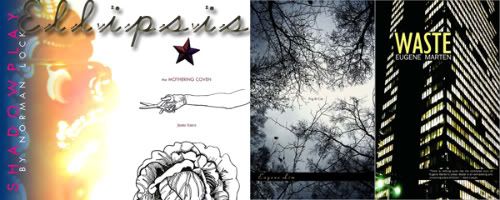
An Interview with Ellipsis Press

Don't be too upset: it's our last interview. Reminisce and check out the others here.


What makes your press different from other publishers?

Ellipsis Press publishes innovative writers who succeed in making new forms in order to express something previously unexpressed, to expand the realm of the articulable. Our books might fall under the heading of "experimental literature," though many people react negatively to the label as it brings to mind opaque styles with no emotional or intellectual payoff, but which we take issue with mostly because it's redundant.

Dalkey Archive, Sun & Moon, McPherson, Coffee House, Calamari, Fairy Tale Review Press, Starcherone, Black Square Editions are just a few of the great small or independent presses in whose tradition and company we hope to belong.

What’s a recent book you’re excited about?

In the spring of 2010 we're going to publish an anthology based on writings that have appeared in the online literary journal, Harp & Altar. Along with some fantastic poetry, it's a great and broad collection of innovative fiction. I believe it represents well what the press is about and the type of work we're interested in publishing.

What advice do you have for emerging writers looking to be published by a small press? What is it about a work that makes you want to publish it?

One person's gutsy transgression is another's mere novelty. What we're looking for is structural or stylistic innovation which also has an intellectual and emotional payoff. This pleasure should be fairly immediately apparent, i.e. not overly delayed or latent (though we can be teased). We will often jump randomly to pages and read whole paragraphs; if your work has a consistency of purpose and language, we'll read more. A great density of references to theoretical texts and/or trendy leftist political slogans and/or graphic and non-ending descriptions of sex or drug episodes generally does not tip the balance in your favor.

Tuesday, March 16, 2010

An Interview with Swan Isle Press

HFR's tribute to small presses. Check out past interviews here!


What makes your press different from other publishers?

Our books. And with great respect for my colleagues in large houses and small, each publishing house essentially has a unique editorial voice based on its authors and books. Those editorial choices, from content to book design, say something to readers about a publisher’s approach to literature, and express a unique identity. Just one example, that’s the way I feel about New Directions, as a reader. So it may be best to defer this question to our readers. In terms of background, Swan Isle Press is an independent, not-for-profit, literary publisher, with strong academic interests as well. Our resources are modest so we’re only able to publish two, sometimes three titles each year and have tried to create a balanced list of fiction, nonfiction, and poetry.

As an NFP publisher, the choice to advance a project is often a lengthy and highly deliberative process since virtually of our books are works in translation and all translations are by respected scholars. It’s very tough being only able to publish just a few books each year since we receive many manuscripts worthy of publication. Every project goes through informal peer review with respected authors and academics who help provide editorial perspective. Swan Isle Press began its life almost ten years ago with books of poetry translated from the Spanish. In 2000, works in Spanish by writers from Spain and Latin America were under-represented, and I perceived that there were unmet needs not only for Spanish speaking readers but also for general readers interested in Spanish and Latin American literatures. So, making original contemporary and classic texts more accessible in single language English translations and bilingual editions is very much a part of Swan Isle Press’s mission and identity.

What’s a recent book you’re excited about?

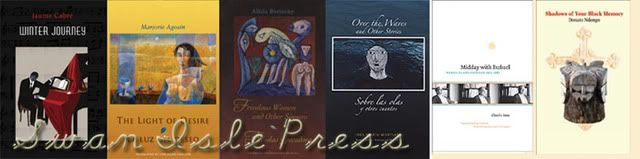
If I may, I’d like to answer in the plural since Swan Isle Press has just released two inspiring new books, Jaume Cabré’s Winter Journey, the first major translation of his work from the original Catalan. This collection of short stories is remarkable on many levels, exquisite prose, and each of the stories mysteriously connected, so that the book can be read as discrete short stories but is really novelistic in terms of the narrative. But that’s for readers to discover…But in addition to the short stories in Winter Journey, there’s a fine epilogue by Jaume Cabré, essentially an essay that provides a generous insight into how the stories evolved, were written over a period of years, and I think would be of interest, instructive for writers interested in both the creative and more practical elements of how a work comes into being.

Swan Isle Press also just released a bilingual Spanish/English edition, The Light of Desire/ La luz del deseo. Poet Marjorie Agosín has written an intensely personal long poem that is both a secular and sacred meditation on love and its many layers of meaning. This beautiful love poem was inspired by The Song of Songs. The poem was written over a four-year span at Jerusalem’s Mishkenot Sha’ananim which is both a neighborhood in Jerusalem and also home to a fine cultural organization for writers and artists. The poem has been sensitively translated Lori Marie Carlson. The edition also features the images of Chilean painter, Ramón Levil. (Mishkenot Sha’ananim is a non-profit, non-governmental organization, which serves both as a guest house for artists and scholars and as an international cultural centre, which may be of interest to HFR readers, writers, artists.)

What advice do you have for emerging writers looking to be published by a small press?

Whether looking toward a small press or large house: Write. That’s my best advice. Simply write and don’t focus on when or who will publish the work. It’s not even a matter of art for art’s sake, noble as that is. Rather learning and honing the craft of writing and discipline required to better express oneself is a fine objective. Starting a project and finishing it. All too often I receive queries, proposals, but the work is only partially completed and it’s clear that the writer has not fully committed to finishing the work, that the only incentive to do so will come from the outside. Frankly, true writers don’t need much advice or encouragement from me or anyone, they will find a way to write under any circumstances. And read. Writers are always good readers. Classics, contemporary works, anywhere one’s tastes and curiosity lead. In terms of submitting a manuscript, it’s best that the writer is familiar with the books on a publisher’s list. I’ve received some very fine manuscripts that are likely worthy of publication, but simply don’t fit within our current list and mission. Wasted motion for both the writer and the publisher. Small presses are modest operations, certainly in comparison to the larger publishing houses, so working with a small press is a highly personalized experience. In fact, it is more of a collaborative experience that brings together a diverse group of extraordinarily creative and passionate individuals who are committed to doing whatever it takes to bring exciting voices and stories to new readers. Audiences too, because Swan Isle Press reaches out to many communities as part of its mission with author readings at schools, universities, various cultural venues. So perhaps on the most practical level, since many small presses focus on a unique literary genre or niche, authors seeking to be published by small presses (or large) would do well to target those presses whose interests are most closely aligned with their own. When the right match is made, the result can be an amazingly rewarding experience for everyone involved.

What is it about a work that makes you want to publish it?

At Swan Isle Press, above all, the focus is on publishing highly original literature that brings a new voice, a new experience, a new perspective to our readers. Now when I say a new voice, virtually every one of our authors, as well as our translators, have been previously published. But as with many works in translation, an English language edition is the first opportunity for readers to be introduced to an author, and our bilingual editions are often the first time Spanish readers have access to certain works as well that might not have been possible otherwise. The book when published should have the potential to open a new world of expression and thought to the reader, and perhaps build some of those proverbial bridges that bring people closer together.

What prompted the founding of the press?

When all is said and done, my desire to embark on Swan Isle Press was because of a love of literature, my own curiosity as a reader, and to provide opportunities for important works to be published which might not otherwise have been possible whether with a for-profit house, or even with other indie NFPs or university presses. There was another significant mission when Swan Isle Press was founded almost ten years ago – the desire to meet an unmet need, namely to introduce outstanding Spanish and Hispanic voices to U.S. American (or English speaking) audiences. In 2000 relatively few presses were devoted to publishing works in translation, especially by little known or unknown writers. While today there are a greater number of small presses publishing works in translation, it’s still a small number as is attested to by Chad Post’s excellent online site Three Percent, which alludes to the very low percentage of books in translation published each year in the U.S.

Most of our books relate to Spanish and Latin American literature, yet Swan Isle still considers its greater mission to publish world literature in translation. Swan Isle expects in the coming years to include books from other languages and cultures on our list of titles and hopes to move that percentage up along with fellow publishers of world literature.

I continue to believe that words and ideas that are intrinsic to books make a difference in our lives, that discourse that’s engendered is vitally important. Indeed, the freedom to read, to write, to be engaged in critical inquiry, and to express oneself is all part of the democracy of books that I hope Swan Isle Press will continue to advance for many years.

It seems like with large publishers in financial straits, the small presses are getting more attention. So we ask: what has your press done to grow?

The economy has affected many sectors during the past couple of years and publishing is no exception, from the largest houses as widely reported in the news, to other publishers with far fewer resources. Swan Isle Press, as a 501(c)(3), independent publisher, has a business model comprised of book revenues and outside funding. We will only continue to grow if our books continue to receive support and that starts with readers. We also look to and depend on funding from various grant makers and other contributors who share in our vision and literary mission. We’re fortunate that many of our books are now being course adopted at various colleges and universities, that public, school, and university libraries have our books in their collections, and that individual readers have made our books part of their own personal libraries. Fulfillment of our mission and the ability to publish more books per year is only limited by time and resources. If your readers are interested in our Press’ unique mission, they can go to our website, www.swanislepress.com, for more information.

Do you see further growth?

The potential for Swan Isle Press is unbounded, except by monetary constraints. And while our priority is publishing books in translation, with high editorial, design and production standards that reflect the quality of our content, we are also eagerly looking forward this coming year to issuing many of our current titles as e-books. It’s yet a new avenue for us to share our books with readers. Many of our books are already in digital form in BiblioVault, a digital repository for books founded by the University of Chicago Press. So we’re very interested in connecting with our readers in new ways. We’ve also just set up a Swan Isle Press Facebook page and hoping our readers will also find that of interest and hope our page will encourage discourse. Growth can be defined in many ways and discovery of new projects, authors, new ways of communicating with readers, and readers with us, those who share our mission, continue to inspire Swan Isle to grow.