Come See our New Website

Tuesday, March 30, 2010

Contributor Spotlight: Carolyne Wright Remembers Poet Ai

I was shocked and saddened to learn of the death of Poet Ai (Florence Anthony Ogawa) ten days ago in Stillwater, Oklahoma. She had apparently gone to the hospital on March 17 with pneumonia, which turned out to be a complication of advanced, and previously undiagnosed, breast cancer. Three days later she was dead. As a full professor of Creative Writing at Oklahoma State University for over a decade, she must have had health insurance–had she not gone to a doctor, or had a checkup? This is a question that hits home in the days just after the massive federal health care bill has passed, and people like Ai--who seemed too tough and ornery to die--are suddenly gone.

Poet Ai and I were colleagues at Oklahoma State in 1999-2000, the year she won the National Book Award for Vice. The department had hired two poets, "Ai and I"--that was the silly homophonic joke I made that year. It was enjoyable to hang out with her and Lisa Lewis--we were the three poets on the faculty, and we tried out every old and new restaurant in Stillwater that year. I liked hearing Ai's anecdotes about poets she had known, some of them quite hard-hitting, and the intricate history of her family. We occasionally visited thrift stores as well, but I was traveling light for that visiting year, so she did more of the purchasing. She joked about her "thrifting," as she called it--it was one of her endearing quirks. She lived quite modestly, in fact, with her cats, her books, her thrifty purchases, her writing and teaching--all the wildness was in the poetry.

Her work was fearless about exploring the darker regions of the human psyche, in the persona poems in the voices of historical figures and celebrities as well as the obscure rural women, outlaws, and renegades of her early books, "Killing Floor" and "Cruelty" especially. These voices gave her great freedom to express emotions that would be constrained in more autobiographical work; but she had been working on a memoir that had her visiting her mother (still living then) and other family members in Texas, Arizona, and elsewhere in the Southwest.

The turquoise necklace she's wearing in the photo accompanying all the obituary notices: she bought that at Red Earth, the Native American festival in Oklahoma City that June. We went together that year (2000), and I also bought a few items, consulting with Ai, because she had very discerning taste in Navajo jewelry. Whenever I wear those pieces, I think of her.

A lot of people out in the wider world of poetry seemed to dislike her, as I learned when I mentioned that she was one of my colleagues that year. Some based their dislike on hearsay, it seems; others had their own anecdotes. But she was also loved and greatly admired by many fellow poets, and especially by many of her students. Ai inspired strong responses in people--and as with all of us, her poet’s personality interacted with those of other poets and was a factor in her own poetic sensibility. Would a less forceful person manage to summon up the forcefulness we admire in her poetry?

I think she would not have minded harsh comments--she would have returned the compliments in kind. ("F**king A"--that was one of her expressions. I heard her deliver it with gusto and an ironic laugh, in a bantering conversation one night in the parking lot after a dinner at one of Stillwater's eateries . . .) She was straightforward, but I observed that she could laugh at her own foibles–she had a sense of humor about herself, and would apologize if someone let her know she had hurt that person’s feelings.

She was controversial, yes, but she was generous to friends. She was a poet friend for that year in Stillwater, and I have mostly memories of good times--eating out, shopping, exchanges of gifts, conversations on everything from politics to po-biz, and moments when bits of conversation would inspire lines of poetry.

My most recent contact with her was after a stay at the Vermont Studio Center in 2003, where her former teacher, poet Norman Dubie, told me that Ai's mother had died. I sent her a card of condolence, and she sent an email to thank me for that. Now it's time for condolences again--this time for Ai herself.

Her work inspired me to be less circumspect in my own work about speaking truth to power, and to allow poems to tell their stories, in whatever voice the dramatic situation calls for. There is power in bluntness and directness, another kind of power in understatement. In my own work, I try for hard-hitting language appropriate to the poem's dramatic situation, so that the directness serves an aesthetic purpose. Ai accomplished this in her own distinctive voices.

Thanks for this chance to write a few words.
*

Carolyne Wright has published eight books of poetry, four volumes of translations from Spanish and Bengali, and a collection of essays. Her latest collection, A Change of Maps (Lost Horse Press, 2006), nominated for the LA Times Book Awards, finalist for the Idaho Prize and Alice Fay di Castagnola Award from the PSA, won the 2007 Independent Book Publishers Bronze Award for Poetry. Her previous book, Seasons of Mangoes and Brainfire (Eastern Washington UP / Lynx House Books, 2nd edition 2005), won the Blue Lynx Prize and the American Book Award. A poem of hers appears in The Best American Poetry 2009 (ed. David Wagoner) and also in the Pushcart Prize XXXIV: Best of the Small Presses (2010). Moving back to her native Seattle in 2005, Wright teaches for the Northwest Institute of Literary Arts’ Whidbey Writers Workshop MFA Program, and for colleges, conferences and festivals around the country. A new book, Mania Klepto: the Book of Eulene, is forthcoming in 2011. Carolyne's translations of poet Kabita Sinha's work appear in HFR #46.

Monday, March 29, 2010

Free Issue Week!


Oh Interns

This week in preparation for the printing of issue #46, Hayden's Ferry will be giving away copies of Issue 45 for free!

  • Check out the Facebook page on Monday around 12pm for instruction on how to win free issues.
  • On Wednesday we will be doing lightning questions through our Twitter (@HaydensFerryRev). So keep an eye on that around noon!
Friday will be the final deadline for our short response questions. The prompt is:

What is the favorite story or poem you've read in any Hayden's Ferry Review, and why?

All answers are a maximum of 100 words, and should be submitted to HFR@asu.edu. All emails need the subject "My Favorite HFR Story" followed by a dash with your name (Ex. My Favorite HFR Story - John Smith). Stories should be submitted as a text attachment in the .doc format.

The winner of the short response will win a two-year free subscription, while the three runner ups will win a free issue.

We are accepting applications for the favorite story now, and they are all due on Friday by noon.

Good luck to everyone. We can't wait to receive your submissions!

Friday, March 26, 2010

News Around the Net

Is true literary translation possible?  Kind of like how eskimos have a thousand words for snow.  Could a person who speaks another language ever really understand?


Writers giving their ten rules for writing, part two.  See what Hilary Mantel, Zadie Smith and Phillip Pullman have to say (Be forewarned: Pullman does not have much to say and you will be scolded).

Apple released some of the prices for ebooks in preparation for the iPad.  The verdict?  Basically the same as the Kindle.  So far, the pricing war between Apple and Amazon seems a bit overblown.

Here's a list of winners of awards from the American Academy of Arts and Letters.  Yes, Daniyal Mueenuddin won more things here.  Did you know he has a Yale law degree to go along with his MFA from University of Arizona?  And his name is hard to spell.  I hate him.  Good short stories though.

They've been a hit with Piper House interns, but have never made an appearance on the blog.  Here's a Times Daily story about Godzilla Haiku.

Wednesday, March 24, 2010

Website of the Week - Scribd

I was waiting on a table this week (Glamorous, I know.) and one of our regulars, knowing my disposition to writing, told me about this little gem called Scribd. I find out on the about page that "Scribd is the largest social publishing company in the world." How have I not found this sooner? The website operates like Flickr, the photo-sharing site, but with words--and so many words in different genres have found themselves opening up to an online community through this organization. Not only is Scribd breaking publishing barriers, but they prompt user interaction and conversation to the hosted written works.

The possibilities are endless: just take a look at the categories through the "Explore" tab. There's a place for Creative Writing, Fiction, Non-Fiction, Business, Magazines, Government Documents...even Children's Books. With an easily accessible interface and straight-forward availability, it could make a writer second guess themselves. So while you're musing about the future of "social publishing" for days on end, give your manuscript (or even just a few poems) a place to rest. It will be among the 10 million documents already published, and as Scribd boasts, many from businesses such as the New York Times, Ford Motor Company, Simon & Schuster, O'Reilly, World Bank, Chicago Tribune, Harvard University Press...the list goes on.

Happy publishing!

Contributor Spotlight: Stephanie Barbé Hammer

Why I write about school

I write about school because I remember kindergarten at the Central Presbyterian Church. It was great: purple finger paint swirling over taped-down paper, dancing with scarves to the church piano, story telling.

And butter making.

One day, while the other kids were working on projects, the teacher took my friend and me into the kindergarten kitchen. She poured cream into a yellow bowl, and we went at it with our child-size eggbeaters. We turned and turned the handles as the little blades whirled, and then the mass inside the bowl became whipped cream.

“Don’t stop,” said our teacher. “It will become butter.”

This seemed preposterous, but it was very fun to work on that whipped cream. We spun those cranks like crazy.

Then - suddenly - the whipped cream looked very different.

“It’s butter now,” my friend whispered. We each took some home and served it at dinner with the rolls.

This miracle in the kindergarten kitchen made me fall in love with school. School was the place where cream was transubstantiated into butter, where your hard work and persistence made that metamorphosis happen.

But I have learned subsequently that school very often is not the place where amazing changes occur. So, I write about how education both enthralls and disappoints me. How it fascinates and enrages me. How much I care for knowledge, despite the managerial offices that both determine the fiscal means of acquiring it, and often – perhaps unwittingly – impede that very acquisition through an array of procedural hoops that would daunt (and do daunt) the people who need the knowledge the most.

The piece that appears in the forthcoming issue of Hayden’s Ferry Review tries - in a fantastical way - to show how the educator’s struggle to preserve knowledge is doomed by misguided beaurocratic imperatives and by the ways in which teachers themselves – in this case, a professor – internalize the very procedures they should be rebelling against. The piece also features and – hopefully - pays homage to the most crucial and most invisible workers at any school – namely the staff. In this sense “Our Friend the Professor” is an odd sort of valentine to the office personnel, IT professionals, bus drivers, and cleaners who helped me when I was a pupil and student and who help me now as a tenured professor.

The fact is that many people make it possible for me, the teacher, to slip into that educational kitchen of miracles. That’s why I write about school. To whip up the impossible, and dish it out as something surprisingly spreadable.

“Yes,” I say. “I made that. “Before it was butter, it was cream.”

“But then it changed entirely.”
*

Stephanie Barbé Hammer’s fiction, non-fiction and poetry have appeared in The Café Irreal, Square Lake, NYCBigCityLit, CRATE, The Red Rock Review, Hot Metal Bridge, Argestes, Soundings, and The Bellevue Literary Review. A two-time nominee for the Pushcart prize, she teaches comparative literature and creative writing at UC Riverside, and is a student in the MFA program at Whidbey Island, Washington. She lives in Los Angeles with her husband, a knitting project, a sometimes-at-home 20 year old daughter, and 12 tiny cacti. Find her online at http://www.stephaniehammer.net

Tuesday, March 23, 2010

Poetry and New Media: A User’s Guide

by Elizabyth Hiscox

The Poetry Foundation’s newly-created Harriet Monroe Poetry Institute, described as “a sort of think tank for poetry,” is a forum that’s all about fostering discussion. What’s fresh about it: its first project focuses on the practical. In poetry? Indeed.

The project deals with poetry in new media and the final report of the initial meeting-of-the-minds, a select group of writers and scholars, is weighty at 74 pages, but readable. A lot of the work of the initial group and focus-groups seems to have centered on fair use and copyright issues. While not the most lyrical discussion, it is timely.

The report is interesting, in part, because it parses out the implications of some of those apocryphal stories of The Great Poets' work being cloistered away that are apparently not apocryphal at all but entirely true. Yes, the lucrative deal for T.S. Eliot’s verse being adapted into a purring Broadway musical. And poor, dear Auden.

The report is also interesting in that it clearly states the case for poetry’s particular peccadilloes. One of the recommendations of the report is to “Reproduce the Original Work Faithfully.” The concept is detailed in the copyright and fair use portion: “This desire for accurate reproduction is especially intense for poets because an unusual level of attention to linguistic detail and discipline is inherent in the art of poetry. Poets meticulously consider punctuation, line breaks, syntax at the smallest level, and even spelling in the construction of poems, so they are unusually concerned that their poems be reproduced not nearly as they appear but precisely as they appear.” Damn straight.

The report also deals with new media, as the name implies, from Kindle to podcasts and beyond. It deals with them quite a bit, but in the context of issues that transcend media formats. If you have a particular beef or concern with a new media outlet, I’d scroll the report to see how they’ve addressed it.

The report’s second section, “The Lifeline of Poetry: Creating Opportunities for Access to and a Lifelong Engagement with the Pleasures of Poetry” moves beyond the legal barriers and ramifications to spell out a plan to deal with various barriers to folks getting access to and spending time with poetry. Namely to create a national study group “to develop a flexible, modular set of guides meant to help people of all ages engage with poetry in a variety of settings ….” Ambitious? Yes. Flawed? Perhaps. But scanning the list of goals for what the guide might do, I’m not going to argue with “model ways of reading poems that do not focus on coming up with ‘correct’ and testable readings but rather encourage engagement, discourse, pleasure, and critical thinking.” Nor am I ready to scoff at the aim to “provide parents with tools for reading and experiencing poetry with their children.” Sounds gravy to me.

And, lest you think it was just a bunch of suits talking shop about stanzas, check the list of the Poetry and New Media Working Group Members: Michael Collier, Wyn Cooper, Rita Dove, Cornelius Eady, David Fenza, Kate Gale, Kimiko Hahn, Lewis Hyde, Fiona McCrae, Robert Pinsky, Claudia Rankine, Alberto Rios, Don Selby, Rick Stevens, Jennifer Urban, Monica Youn. I think the poet’s voice might have gotten heard at that table, don’t you?

The report doesn’t pretend to speak for everyone, but honestly raises some questions about use that are in need of some, yes, “creative” answers. It deals with the stuff that many of us wish was already in place. The safeguards that might allow us to get down to the business of being creative already. The infrastructure that allows the next generation (and the previous) to access poetry with the passion and ease that we might. It’s a project that’s overdue, and while it may be a somewhat dry read it could just whet your appetite to change the world.

Monday, March 22, 2010

Free Association Poetry - One Year Anniversary Reading Tuesday April 9th

One year ago, a group of accomplished poets from Glendale and Surprise formed the Rorschach Poetry Collective to spread live literary arts into the West Valley. Over the past year, they have organized poetry events for the West Valley Art Museum and locally owned coffeehouses, but their monthly open mic reading at Glendale Community College (called Free Association) has remained the focal point of their literary sprawl.

These monthly events welcome and encourage community participation, through open mic readings and are free and open to the public. Each month also brings two distinguished featured poets, so West Valley crowds can be exposed to a diverse sample of the best writers from other scenes, ranging from widely published academics to National slam champions and performance poets. April's Anniversary Celebration will be a good example of the kind of poetic diversity that we integrate, on a monthly basis.

------------------
Free Association Open Mic Poetry Reading. One-Year Anniversary Celebration. Tuesday April 13th at Glendale Community College. with special featured poets Bakeem Lloyd & Patricia Colleen Murphy. FREE and open to the public. open mic starts at 7pm. hosted by Shawnte Orion
Glendale Comunity College (in Student Union room 104ABC). 6000 W. Olive Ave. Glendale, AZ 85302.

Friday, March 19, 2010

News Around the Net

The Atlantic has come crawling back to short fiction writers. We knew you would. Now we have to decide whether we're willing to take you back.

Want to read William Faulkner's Nobel Prize speech from 1950? Why wouldn't you? I promise it's not narrated by a mentally challenged six year old. But he might have been drunk.

Nathan Bransford wants to know which book we'd want with us if deserted on a desert island. My answer? Elixir by Hilary Duff. The beautiful, lyrical, heart-wrenching story of whatever the hell it's about.

Annoyed by your lack of creativity? Think more like a seven year old. It works. It's science. Soft science, but science nonetheless.

The long list for the Orange Prize in fiction, a female writer's award, has been announced. Big names include the ubiquitous Hilary Mantel (not Duff), Lorrie Moore and Barbara Kingsolver.

Want friends and conversation? Read War and Peace. It seems to work. It's actually a cool essay. Read it, if you please.


The Guardian gives us some advice on what not to name your novel. Ten bucks says Dan Brown calls his next novel The Armageddon Code after reading this.

Literary t-shirts for everyone!

Thursday, March 18, 2010

An Interview with Ellipsis Press

Don't be too upset: it's our last interview. Reminisce and check out the others here.


What makes your press different from other publishers?

Ellipsis Press publishes innovative writers who succeed in making new forms in order to express something previously unexpressed, to expand the realm of the articulable. Our books might fall under the heading of "experimental literature," though many people react negatively to the label as it brings to mind opaque styles with no emotional or intellectual payoff, but which we take issue with mostly because it's redundant.

Dalkey Archive, Sun & Moon, McPherson, Coffee House, Calamari, Fairy Tale Review Press, Starcherone, Black Square Editions are just a few of the great small or independent presses in whose tradition and company we hope to belong.

What’s a recent book you’re excited about?

In the spring of 2010 we're going to publish an anthology based on writings that have appeared in the online literary journal, Harp & Altar. Along with some fantastic poetry, it's a great and broad collection of innovative fiction. I believe it represents well what the press is about and the type of work we're interested in publishing.

What advice do you have for emerging writers looking to be published by a small press? What is it about a work that makes you want to publish it?

One person's gutsy transgression is another's mere novelty. What we're looking for is structural or stylistic innovation which also has an intellectual and emotional payoff. This pleasure should be fairly immediately apparent, i.e. not overly delayed or latent (though we can be teased). We will often jump randomly to pages and read whole paragraphs; if your work has a consistency of purpose and language, we'll read more. A great density of references to theoretical texts and/or trendy leftist political slogans and/or graphic and non-ending descriptions of sex or drug episodes generally does not tip the balance in your favor.

Website of the Week - Librophile


Do you like Audiobooks? Although I am quite new to the concept of having a book read to me by my headphones, I have taken a liking to catching up on the classics while riding a bike.

My search for free, high-quality content brought me to Librophile. Librophile is a web application that combines the public domain audiobook repository LibriVox and the for-pay audiobook portal Audible. The site allows users to see and preview all copies of cataloged audiobooks, so that you can either download them for free or buy them. The site also allows you to subscribe to audiobooks through RSS. Overall the site has a slick interface, along with plenty of free content.

Wednesday, March 17, 2010

Jobs!

Illinois College. The Illinois College English Department is now accepting applications for the position of Claridge Writer-in-Residence, a one-semester teaching position in Creative Writing, for the spring semester of 2011 (January 10-May 15). The primary responsibilities for the position include teaching an introductory-level multiple-genre creative writing class & an advanced writing workshop in a genre of choice. The resident writer will also give two public readings, visit area schools, & work informally with student writers. Beyond these duties, the position is intended to offer a productive writer substantial time to write. The ideal candidate for this position is a talented writer with publications in at least two genres, who is also an energetic, experienced teacher of writing. A MFA or Ph.D. in Creative Writing or English is required. The salary for this teaching residency is $24,000 & partial benefits, including a furnished apartment. The application for the Claridge Writer-in-Residence should consist of a cover letter, a substantial writing sample (a dozen poems or twenty pages of prose from at least two works), a curriculum vitae, undergraduate & graduate transcripts & three letters of recommendation. The application should provide evidence of strong teaching. Send these materials to: Ms. Elise Meyer & Dr. Robert Koepp, Chair, English Department, Illinois College, Office of Academic Affairs, 1101 W. College Avenue, Jacksonville, IL 62650. Review of applications will begin March 15, 2010, & will continue until the position is filled.Illinois College (founded in 1829) is a dynamic private, Phi Beta Kappa, liberal arts college located in Jacksonville (West Central), Illinois.

The Department of Literature, Language, Writing, and Philosophy at Fairleigh Dickinson University's College at Florham is seeking a well-rounded and flexible Creative Writing/Fiction faculty member to fill a tenure-track Assistant Professor line. This individual will teach in an innovative and rapidly growing program in Creative Writing. Candidates should be able to demonstrate a commitment to undergraduate education and advising, teaching effectiveness, writing for publication and service. Position subject to budgetary approval. MFA and/or significant publication with leading publishers required for teaching Creative Writing/Fiction. Book publication on a major press required. Employment is contingent upon a satisfactory background check. Candidates for hire will be required to sign a waiver authorizing the background check and produce a Social Security Card. Interested candidates can learn more about and apply for this position through the University's Web site (www.fdu.edu) by clicking on the Employment link at the bottom of the page. Contact: Professor Peter Benson, Chair Application Information. Contact: Peter Benson/ Literature, Language, Writing and Philosophy/ Fairleigh Dickinson University/ Online App. Form: https://jobs.fdu.edu.

Distinguished Visiting Writer: Bowling Green State University. The English Department seeks applicants for the College of Arts & Sciences Distinguished Visiting Writer. The successful candidate will be in residence spring 2011; teach one fiction writing workshop in our BFA program and one workshop in our MFA program; give a reading and a lecture; and advise theses. Qualifications: 1) MA, MFA or Ph.D. by time of employment; 2) at least one book of fiction and critical recognition consistent with a writer of national reputation; and 3) evidence of outstanding teaching. Salary: competitive. See our website, www.bgsu.edu/departments/creative-writing/visitingwriter.html, for a fuller description of the position. Send cover letter, CV, transcripts, three current letters of reference, writing sample (one book), a list of courses taught with brief descriptions, and 1-2 samples of undergraduate syllabi to Kristine Blair, Chair, English Department, Bowling Green State University, Bowling Green, Ohio 43403-0191. The starting date of employment for this position is January 2011. Screening of applicants will begin June 14, 2010 and continue until the position is filled. BGSU is an Equal Employment Opportunity/Affirmative Action Employer and encourages applications from women, minorities, veterans, and individuals with disabilities. Application Information Postal Address: Kristine L. Blair, Chair/ English Department/ Bowling Green State University/ 1001 E. Wooster St./ Bowling Green, OH 43403-0191/ Phone: 419-372-7543.

Writing: Assistant Professor, Fiction Writing, Department of English, Ball State University, Muncie, Indiana. Tenure-track position available August 20, 2010. Responsibilities: teach and develop a wide range of undergraduate and graduate creative writing courses, particularly in fiction; publish fiction. Minimum qualifications: earned MFA or Ph.D. in creative writing by August 1, 2010; strong record of publication in fiction; record of effective teaching at the college or university level. Preferred qualifications: one published book of fiction; secondary specialization in poetry or screenwriting (with record of publication or production); experience in digital media, creative writing program administration, or community-based education. Send letter of application, curriculum vitae, and copies of graduate transcripts as pdf or MSWord attachments to (replace (at) with @) or by mail to: Professor Jill Christman, Chair, Tenure-Track Creative Writing Search Committee, Department of English Ball State University, Muncie, Indiana 47306; fax: 765-285-3765. After initial review of applications, selected candidates will be asked to supply a writing sample (20 pp of fiction), statement of teaching philosophy for creative writing, and three letters of recommendation; interviews to be held in Denver at the Association of Writers and Writing Programs annual conference, April 8-10, 2010. Review of applications will begin March 1, 2010, and will continue until the position is filled. http://www.bsu.edu/English. Ball State University is an equal opportunity, affirmative action employer and is strongly and actively committed to diversity within its community.

Online Journal Studio Invites Submissions for Special Arizona Writers Issue

Studio invites submissions for a special issue featuring Arizona writers. To be published in the summer of 2010, Studio@Arizona (volume 4, no 2) will feature poetry, creative non-fiction, translations and short fiction written by Arizona writers. Arizona writers and artists are invited to submit current literary works to Studio’s poetry, essay, translations and short fiction sections, as well as audio recordings and visual art collaborations for Studio’s Gallery section. Additionally, the editor welcomes submissions for a section on the Sonoran Desert and the Arizona environment. This special issue of Studio will also feature an essay on cross-border creative exchanges between Canada and the Arizona/ASU region, as well as indigenous Arizona writers and past Canada U.S. Fulbright Chairs at the Piper Center for Creative Writing. Visit Studio to see the current issue, archived issues, as well as the submission guidelines. Send submissions with the subject header Studio@Arizona to: studioarizona@gmail.com. Deadline: July 1, 2010.

Rishma Dunlop, Studio Editor
Canada-U.S. Fulbright Research Chair of Creative Writing
Piper Center for Creative Writing
Arizona State University
For specific inquiries, please contact the editor at rishma.dunlop@gmail.com

Tuesday, March 16, 2010

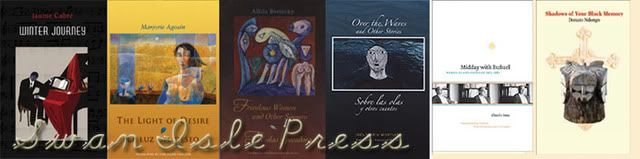
An Interview with Swan Isle Press

HFR's tribute to small presses. Check out past interviews here!


What makes your press different from other publishers?

Our books. And with great respect for my colleagues in large houses and small, each publishing house essentially has a unique editorial voice based on its authors and books. Those editorial choices, from content to book design, say something to readers about a publisher’s approach to literature, and express a unique identity. Just one example, that’s the way I feel about New Directions, as a reader. So it may be best to defer this question to our readers. In terms of background, Swan Isle Press is an independent, not-for-profit, literary publisher, with strong academic interests as well. Our resources are modest so we’re only able to publish two, sometimes three titles each year and have tried to create a balanced list of fiction, nonfiction, and poetry.

As an NFP publisher, the choice to advance a project is often a lengthy and highly deliberative process since virtually of our books are works in translation and all translations are by respected scholars. It’s very tough being only able to publish just a few books each year since we receive many manuscripts worthy of publication. Every project goes through informal peer review with respected authors and academics who help provide editorial perspective. Swan Isle Press began its life almost ten years ago with books of poetry translated from the Spanish. In 2000, works in Spanish by writers from Spain and Latin America were under-represented, and I perceived that there were unmet needs not only for Spanish speaking readers but also for general readers interested in Spanish and Latin American literatures. So, making original contemporary and classic texts more accessible in single language English translations and bilingual editions is very much a part of Swan Isle Press’s mission and identity.

What’s a recent book you’re excited about?

If I may, I’d like to answer in the plural since Swan Isle Press has just released two inspiring new books, Jaume Cabré’s Winter Journey, the first major translation of his work from the original Catalan. This collection of short stories is remarkable on many levels, exquisite prose, and each of the stories mysteriously connected, so that the book can be read as discrete short stories but is really novelistic in terms of the narrative. But that’s for readers to discover…But in addition to the short stories in Winter Journey, there’s a fine epilogue by Jaume Cabré, essentially an essay that provides a generous insight into how the stories evolved, were written over a period of years, and I think would be of interest, instructive for writers interested in both the creative and more practical elements of how a work comes into being.

Swan Isle Press also just released a bilingual Spanish/English edition, The Light of Desire/ La luz del deseo. Poet Marjorie Agosín has written an intensely personal long poem that is both a secular and sacred meditation on love and its many layers of meaning. This beautiful love poem was inspired by The Song of Songs. The poem was written over a four-year span at Jerusalem’s Mishkenot Sha’ananim which is both a neighborhood in Jerusalem and also home to a fine cultural organization for writers and artists. The poem has been sensitively translated Lori Marie Carlson. The edition also features the images of Chilean painter, Ramón Levil. (Mishkenot Sha’ananim is a non-profit, non-governmental organization, which serves both as a guest house for artists and scholars and as an international cultural centre, which may be of interest to HFR readers, writers, artists.)

What advice do you have for emerging writers looking to be published by a small press?

Whether looking toward a small press or large house: Write. That’s my best advice. Simply write and don’t focus on when or who will publish the work. It’s not even a matter of art for art’s sake, noble as that is. Rather learning and honing the craft of writing and discipline required to better express oneself is a fine objective. Starting a project and finishing it. All too often I receive queries, proposals, but the work is only partially completed and it’s clear that the writer has not fully committed to finishing the work, that the only incentive to do so will come from the outside. Frankly, true writers don’t need much advice or encouragement from me or anyone, they will find a way to write under any circumstances. And read. Writers are always good readers. Classics, contemporary works, anywhere one’s tastes and curiosity lead. In terms of submitting a manuscript, it’s best that the writer is familiar with the books on a publisher’s list. I’ve received some very fine manuscripts that are likely worthy of publication, but simply don’t fit within our current list and mission. Wasted motion for both the writer and the publisher. Small presses are modest operations, certainly in comparison to the larger publishing houses, so working with a small press is a highly personalized experience. In fact, it is more of a collaborative experience that brings together a diverse group of extraordinarily creative and passionate individuals who are committed to doing whatever it takes to bring exciting voices and stories to new readers. Audiences too, because Swan Isle Press reaches out to many communities as part of its mission with author readings at schools, universities, various cultural venues. So perhaps on the most practical level, since many small presses focus on a unique literary genre or niche, authors seeking to be published by small presses (or large) would do well to target those presses whose interests are most closely aligned with their own. When the right match is made, the result can be an amazingly rewarding experience for everyone involved.

What is it about a work that makes you want to publish it?

At Swan Isle Press, above all, the focus is on publishing highly original literature that brings a new voice, a new experience, a new perspective to our readers. Now when I say a new voice, virtually every one of our authors, as well as our translators, have been previously published. But as with many works in translation, an English language edition is the first opportunity for readers to be introduced to an author, and our bilingual editions are often the first time Spanish readers have access to certain works as well that might not have been possible otherwise. The book when published should have the potential to open a new world of expression and thought to the reader, and perhaps build some of those proverbial bridges that bring people closer together.

What prompted the founding of the press?

When all is said and done, my desire to embark on Swan Isle Press was because of a love of literature, my own curiosity as a reader, and to provide opportunities for important works to be published which might not otherwise have been possible whether with a for-profit house, or even with other indie NFPs or university presses. There was another significant mission when Swan Isle Press was founded almost ten years ago – the desire to meet an unmet need, namely to introduce outstanding Spanish and Hispanic voices to U.S. American (or English speaking) audiences. In 2000 relatively few presses were devoted to publishing works in translation, especially by little known or unknown writers. While today there are a greater number of small presses publishing works in translation, it’s still a small number as is attested to by Chad Post’s excellent online site Three Percent, which alludes to the very low percentage of books in translation published each year in the U.S.

Most of our books relate to Spanish and Latin American literature, yet Swan Isle still considers its greater mission to publish world literature in translation. Swan Isle expects in the coming years to include books from other languages and cultures on our list of titles and hopes to move that percentage up along with fellow publishers of world literature.

I continue to believe that words and ideas that are intrinsic to books make a difference in our lives, that discourse that’s engendered is vitally important. Indeed, the freedom to read, to write, to be engaged in critical inquiry, and to express oneself is all part of the democracy of books that I hope Swan Isle Press will continue to advance for many years.

It seems like with large publishers in financial straits, the small presses are getting more attention. So we ask: what has your press done to grow?

The economy has affected many sectors during the past couple of years and publishing is no exception, from the largest houses as widely reported in the news, to other publishers with far fewer resources. Swan Isle Press, as a 501(c)(3), independent publisher, has a business model comprised of book revenues and outside funding. We will only continue to grow if our books continue to receive support and that starts with readers. We also look to and depend on funding from various grant makers and other contributors who share in our vision and literary mission. We’re fortunate that many of our books are now being course adopted at various colleges and universities, that public, school, and university libraries have our books in their collections, and that individual readers have made our books part of their own personal libraries. Fulfillment of our mission and the ability to publish more books per year is only limited by time and resources. If your readers are interested in our Press’ unique mission, they can go to our website, www.swanislepress.com, for more information.

Do you see further growth?

The potential for Swan Isle Press is unbounded, except by monetary constraints. And while our priority is publishing books in translation, with high editorial, design and production standards that reflect the quality of our content, we are also eagerly looking forward this coming year to issuing many of our current titles as e-books. It’s yet a new avenue for us to share our books with readers. Many of our books are already in digital form in BiblioVault, a digital repository for books founded by the University of Chicago Press. So we’re very interested in connecting with our readers in new ways. We’ve also just set up a Swan Isle Press Facebook page and hoping our readers will also find that of interest and hope our page will encourage discourse. Growth can be defined in many ways and discovery of new projects, authors, new ways of communicating with readers, and readers with us, those who share our mission, continue to inspire Swan Isle to grow.

Monday, March 15, 2010

Contributor Spotlight: Corinna McClanahan Schroeder

Last winter, I tried writing a poem about a car wreck, loosely based on a college experience. A friend and fellow poet, after reading a draft full of description, reminded me that the reader of the poem wants a little mystery, and for that reason, a poem should trust its reader to connect the pieces of information. It was a comment that I’d heard many times, one that, for the most part, I’d linked with ideas of concision and paring. But when my friend said those words—mystery, trust—she made that lesson new and imperative for me. I started writing with an eye for the mysterious and the ominous, for the double-meaning and the omitted, and for the deceivingly-quiet tone. I also started reading with this lens, ready to let myself be schooled by any “mysterious” poets I could find.

Wonderfully—and yes, maybe a bit mysteriously—I found what I needed. A few weeks later, the same friend gave me her extra copy of Kate Northrop’s first book, Back Through Interruption (Kent State, 2002). From the first poem, I knew that I had found a mentor in Northrop. Strangely enough, her book begins with “Iowa and Other Accidents,” a poem about a car wreck which closes with “the gray sedan lifting slowly from the common snow, / turning, and the accident / always there, about to happen.” Northrop ends at the point of wreck, and by delivering the reader right up to this event and then omitting any description of it, she subverts the typical beginning-middle-end narrative line. The conclusion never happens, and so the tension is raised and then maintained even after the poem’s ending—a difficult effect to accomplish. By resisting closure, the poem lingers, and it’s still doing just that for me, months after my initial read.

From “Iowa and Other Accidents,” the book continues in Northrop’s quiet but charged voice, full of darkening landscapes and loss that is both actual and approaching. In “Two Stories with Wish & Leap,” for example, “Nothing much is known about the girl— / if she hesitated, how she looked / up there on the railing.” Eventually, the reader comes to learn that this girl has been lost to the river in a flood, but what I love about this poem is that its speakers are as much in the dark as the reader is: “We weren’t awake / at the story’s end,” but “[e]ither way we trust the fact—which is / absence—a girl inside the water.” Instead of all-knowing speakers, Northrop offers a collective voice that can only draw its conclusions from what—or who—is no longer present. Whereas a tidy narrative would seek to impose meaning on this drowning, this is a poem of tragedy, and the honesty of human experience is preserved in the poem’s fragmented nature.

Despite the poems’ resistance to definitive conclusions, though, they contain an impressive clarity which simultaneously accompanies the mystery. The speaker in “The Visitor,” for example, who is watching “the neighbors’ children / turn to dusk,” remembers a visitor from her own childhood who came “by the back road where stones glowed pale / in the moonlight” when “I was too young, [when] I still thought / I belonged to the world.” The scene is ghostly—the speaker is “in the picture window, thin / and distant like the glimpse / of a surfacing fish”—but the reader is also grounded in the specificity of “the field of sweet alfalfa” and in the precision of the speaker’s desire, even if the reader never knows who the visitor is: “Come back / and bring your finest wine, the oldest bottle. / Bring that strange dusty book you were reading.” As with Northrop’s best poems, there is both mystery and transparency here.

The poems that I’ve mentioned all come from Northrop’s first section, but I could pick randomly from the book’s pages and find the same wonderful mystery that I find in these few examples. Sometimes this mystery is the result of events excluded. Other times, it is the result of a failure of language. Regardless of method, though, Northrop really trusts her reader to enjoy the ambiguities that she presents. In that way, her work serves as a great reminder that the right amount of mystery allows a reader not only to participate in a poem, working to put its pieces together, but to become truly invested in a poem. That, in the end, is its great reward.
*

Corinna McClanahan Schroeder is currently completing her MFA degree at the University of Mississippi where she is the recipient of a John and Renée Grisham Fellowship. Her work has recently appeared or is forthcoming in Copper Nickel, Measure, Conte, and The Country Dog Review.

Friday, March 12, 2010

News Around the Net

The National Book Critics Circle Awards have been announced. And Hilary Mantel adds to her Booker Prize. Congrats.


If you're into Cormac McCarthy (and who isn't?), you might want to check out this spring's issue of The Phoenix, the University of Tennessee's literary journal. They're publishing two uncollected works by Cormac from 1959 and 1960. Kind of a big deal.

On getting started in publishing. Best (and most depressing) part: "It's easy to get published; it's just hard to get paid." Oh well...

Virginia Woolf said all a woman needs to write a novel are money and a room of her own. The Hoskins Houses Trust is taking that literally. Why can't a homeless person write a masterpiece? All they need is a street corner of their own.

Which writer's career would you most like to emulate? Do you even have to ask? Pick from the list: Dan Brown, JK Rowling, or a certain founder of a Bay Area quarterly. More on him some other time.

The writing archive of David Foster Wallace has been acquired by the University of Texas at Austin. Soon, all his unpublished manuscripts and early drafts will be open to the public. Is that even a good thing? Isn't the finished product all that matters?

Poetry in the digital age. Welcome to the 21st Century!

Thursday, March 11, 2010

Website of the Week - The Book Seer

So I saw my fellow intern, Mike, reading the Dave Eggers classic, A Heartbreaking Work of Staggering Genius. Since I want to become better friends with Mike, I decided to find recommendations for his next book selection, using a little book-know-how to worm my way in. I surfed on over to The Book Seer, a service that lets you look for books that are similar to the one that you just finished reading, like a Pandora for books, and found Four Souls by Louise Erdrich and Erasure by Percival Everett to recommend to him.

Mike was filled with emotion and we are now best friends. Hooray for Book Seer!


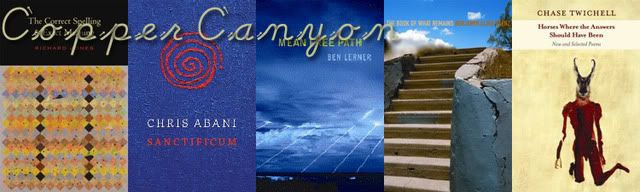
An Interview with Copper Canyon Press

HFR's tribute to small presses strikes again. Check out our past interviews here!


What makes your press different from other publishers?

Our press is unique in the effort we put into developing and maintaining intimate relations with our authors as well as with our readership. We pride ourselves on the focus and dedication of our small staff, which is realized in the quality of the books we produce. Our diversity of publications range from reprints to major authors and emerging poets; as well as translations from Estonian and Arabic to Bengali and Spanish. The publication style of translations that we employ is noteworthy due to the presentation of bilingual editions with the original poem en face. We follow the dictum “The practice of translation is plainly impossible and nevertheless indispensable.” – W.S. Merwin.

What’s a recent book you’re excited about?

A book we’re particularly excited about is Richard Jones’ The Correct Spelling & Exact Meaning. We’ve been publishing Jones since the eighties, and have always felt a strong kinship with his work. As a staff we recently read his newest manuscript in a reading group setting, and were reinvigorated by his poems, such as “The Lesson”, “Miracles”, “Shadow Boxing”, “The Span”, “The Face”, “King of Hearts”, “This Blue World”, and “The Pyramid.” One of the staff mentioned that Jones should be read by Garrison Keillor on The Writer’s Almanac, and eerily enough, Keillor read him the very next day.

What advice do you have for emerging writers looking to be published by a small press? What is it about a work that makes you want to publish it?

We recommend that aspiring authors educate themselves on the requirements of publication with any given press, as well as well as that publisher’s reputation, history, and published work. Our advice to would-be poets can be best explained by Copper Canyon poets Marvin Bell, John Haines, and Eleanor M. Hamilton, whose thoughts on the writing and publishing process are available on our website, under the “Getting Published” tab. We would encourage reading W.S. Merwin’s “Berryman”, and Hayden Carruth’s “On the Impossible Indispensability of the Ars Poetica” as other sentiments of advice.

What prompted the founding of the press?

Copper Canyon Press founders Sam Hamill, Tree Swenson, William O’Daly, and Jim Gautney envisioned a press that would exhibit the vitality of poetry that they believed was necessary to the human condition.

It seems like with large publishers in financial straits, the small presses are getting more attention. So we ask: what has your press done to grow? Do you see further growth?

Our status as a non-profit publisher dictates our ethic and continuing efforts to cultivate a thriving relationship with our donors and readers. It speaks to the importance of constant growth that our Development Committee is continually working towards garnering more support, while sustaining current relationships. We supplement developmental campaigns with marketing and publicity initiatives that serve to expand the audience of readers for our books. This currently involves branching out into the world of social medias, i.e. Facebook, blogging, and maintaining an ever-evolving web presence.

How big can a press be and still be considered small?

Such distinctions are made in the publishing industry according to organizational budgets. Our budget is miniscule, yet our reach is large. Additionally, we are considered a small press because we rely on a core staff of six members, supplemented by a strong intern program.


Visit Copper Canyon's website here.

Wednesday, March 10, 2010

Unusual Calls for Submissions

call for submissions: Stymie Magazine
Stymie Magazine, a journal of sport & literature, is seeking submissions for their upcoming 2010 issues (Spring/Summer and Autumn/Winter). Past contributors and those already slated to appear in the near future include: Matt Ferrence, Daniel Orozco, Brian Oliu, Lee Gruenfeld, Ben Loory, Dawn Corrigan and many others. In terms of what we’re about, our magazine is focused on sport in literature, be it through fiction, poetry, creative nonfiction or essay. We love the sport themed work (i.e. baseball) published at places like Hobart and The Southern Review, and other places like Golf World (in their annual fiction issue). We're partial to the essays of David Foster Wallace. We'd be ecstatic to get an essay on 1986's Double Dribble for the NES. We are currently reading submissions, our complete guidelines can be found here.

Online Journal Seeks Submissions for Issue 2: Super Arrow

Super Arrow, the online journal for experiments in writing and art, has re-opened submissions through 3.31.10 for Issue 2. Visit the blog at superarrow.blogspot.com for guidelines and the new assignment: CROWDMAP. Dig into Issue 1 at superarrow.org, and e-mail superarrowfliestrue(at)gmail.com (replace (at) with @) with questions.

Twitter-based literary review seeks submissions: escarp
escarp, a selective, Twitter-based review of brief poetry and prose, is seeking submissions of brief (sub 140 character) fiction, non-fiction and poetry. While most of our submissions to date are best described as poetry or fiction, we also like to encourage the submission of brief non-fiction. Public interest in brief non-fiction is best demonstrated by the popularity of “genre” non-fiction sites, if you will—FML [fmylife.com], MLIA [mylifeisaverage.com], TFLN [textsfromlastnight.com], Overheard It [overheard.it], etc.—for which we’ve seen little “literary” competition. You can find us on the web at escarp.org. To submit you’ll need to: 1.) make/have a Twitter account, 2.) follow @escarp: twitter.com/escarp 3.) wait for us to follow you back (we process follows several times a day) 4.) submit, via direct message; specific requirements: escarp.org/submit.php. Writers can expect personal submission responses within 24 hours. Some balk at creating a Twitter account just to submit to a journal, but we’ll note—given the proliferation of online submission management systems requiring registration—that signing up for Twitter is easier, less invasive, and can actually serve more than one purpose.

Subject: Call for Submissions: Anthology of Women's Stories of Becoming
The University of Nebraska Women's Center is publishing the anthology Becoming, edited by Jill McCabe Johnson. The editors seek personal narratives and a small number of poems relaying the story of a formative experience that helped shape the woman you've become. Please send one personal narrative or one autobiographical poem to: becominganthology(at)gmail.com (replace (at) with @). Files must be in .doc, .docx, .pdf, or .rtf formats. Files should be named with the word poetry or prose followed by the author’s last name. Poems should be one page or less. Personal narratives can be up to 1,000 words. Please note: only a handful of poems will be selected for the anthology. In your email, please include: Name, Address, Email address, Phone, Title of submission, Genre. If your submission was previously published please include the publication title, edition, and date For full guidelines, go here.

Call for Environmental Writing - CNF, Essay, Personal Narrative, Co-creation with Spirit, Nature & Humankind.
Anthology seeks short, 500-1000 words preferred, essay, personal narrative, CNF on environmental topics: Green Teens; Ban the Plastic Bag; Claim Your Watershed; Restore a River; Sustainability; The Heart as Sacred Space; Ceremony; Dance as Prayer; Personal Responsibility; bio’s & work of Change-Making Environmentalists such as Kenya’s Wangari Maathai; Sustainable Towns, i.e. Bellingham WA., CSA; Adding Value/Reverent Attention in Business; The Paradigm of Living in Harmony with Mother Earth; Indigenous Wisdom & Climate Change; etc. Contributors receive a free complimentary copy, a 50 word bio with contact info both in print and on web site and the opportunity of being in print with such notables as Mary Oliver, Barbara Kingsolver, Jose Stevens, Alex Stark, etc. Deadline: April 15, 2010 Send attachments in Word to hazelheron.press(at)gmail.com; find more information here.

To Think - To Write - To Publish Fellowship

A unique writing and publishing fellowship: To Think-To Write-To Publish--A program for "next generation" writers of any genre with an interest in science and technology. Learn creative nonfiction techniques. Develop and pitch ideas to book and magazine editors and literary agents. Publish your work. Featuring two intense days of writing, highlighted by an intimate and practical workshop with Lee Gutkind, author and editor of Creative Nonfiction Magazine and a conversation with New York Times science writer, Gina Kolata and Vice President and senior editor for Free Press, Leslie Meredith. Participants will enjoy an all expenses paid, five day retreat as the guest of the Consortium for Science, Policy & Outcomes at Arizona State University, including a stay at the Mission Palms Hotel, Tempe, Arizona, plus a $500 honorarium. Application deadline is March 15, 2010. For more details see our flier. If you have specific questions, contact 2think2write2publish@gmail.com or to apply: simply send a bio and letter of interest to CSPO@asu.edu.

Tuesday, March 9, 2010

An Interview with Four Way Books

HFR's tribute to small presses continues. Check out our past interviews here!


What makes us different from other publishers?

It’s hard to approach this question as there are tiers of difference (small presses are different from large, and Four Way is different from other small houses…) — I can tell you what our authors seem to most appreciate: our balance of close editorial attention and aggressive promotion. Commercial houses often can’t be bothered with that kind of attention (to non-blockbusters anyway) and small presses often can’t afford to do as much as they’d like. When Michael Wiegers, the director of Copper Canyon Press, was here at ASU he made a great distinction between “publishing” and “privashing”: it’s crucial to bring books to readers, not just make them into lovely objects.

At Four Way Books, we all—editors, designers, publicity staff—get to know each book, and each author, and I think most authors get a sense of the whole team supporting their book’s publication. We work hard to find each book a real audience (this spring we’ll publish Monica Youn’s Ignatz, a collection partially inspired by George Herriman’s early 20th century comic; we’re promoting the book in all the usual ways, and also to Krazy Kat clubs. Ker plow!)

Also, I cherish the fact that we do not publish according to one aesthetic: there are three of us who acquire books and none of us is predictably wedded to a style or school. Our list has room for the compression and wit and hunger of Alissa Valles, the erudition, formal elegance and spiritual unrest of Daniel Tobin, the sweet hyper-precision about both real and imaginary things that animates the poems of C.S. Carrier...

A recent book I’m excited about?

Luckily for me, there are too many to do justice to. One that’s unusual is Daniel Simko’s posthumous collection The Arrival. It came to us via one of its editors, Simko’s close friend Carolyn Forché, who also wrote the introduction. Simko was ten years old when the Soviets invaded Czechoslovakia, and he and his family emigrated to the US in 1969. He lived most of his life in New York. These lines are from the poem “Departure” which opens the collection,

I am entering this room for the last time.

I am entering you the way an angel enters a scythe.

Advice for emerging writers:

Don’t submit your book too soon. Don’t rush. Think about Stephen Dobyns’ essays in Best Words, Best Order (just think about that title!): we can only meet you for the first time once. Make sure your work is ready. Cut the poems you’ve been wondering about (if deep down you know you are holding on for some sentimental reason or for length-o’-manuscript, rather than for aesthetic value). Listen to your own instincts but also listen to your trusted readers (teachers, friends, fellow writers from your student years): that’s not obeisance I’m advocating, but deep listening. The competition is real, and your cover letter is not going to make a big difference. Don’t send the book off because you want to get out from under it: make sure you’ve done the work the poems have offered to you to do.

What is it about a book that makes me want to publish it?

The mind in motion in its pages.

Founding of the press:

Four Way Books was founded seventeen years ago by four writers who wanted to make a hospitable home for poetry as the major New York houses were publishing less and less of it. You’ll notice that poetry now in 2010 has a very strong cast of independent presses who publish most of what appears in print in a given year: BOA, Copper Canyon, Fence, Four Way, Graywolf, Sarabande, Tupelo… some of whom also publish fiction (as Four Way Books has since 2008): I think poetry hit hard times in NY before fiction did, and has had time to build an independent infrastructure that is increasingly strong. Literary fiction is now hip-deep in that same process.

Four Way Books is rising and thriving, and we’ve always been dedicated to creating opportunities for writers of merit in addition to publishing their work. To that end, we send one writer each year to a writer’s retreat (usually the Fine Arts Work Center in Provincetown, Massachusetts) for a month in support of new work. We have a long view: and we are thrilled when we can follow someone over a career. In fact, as our backlist grows and as we publish more fiction, we’ve decided to increase the number of books we publish each year (from 6-8 to 8-11—as much as a 30% increase!) which makes it easier to continue to take on new authors and to keep publishing the best work of our returning authors, in both poetry and fiction.

What is our relationship with small magazines and journals?

We love them. We are grateful they exist.

Monday, March 8, 2010

Contributor Spotlight: Phil Estes

As I typed this in Gmail, Google suggested the dunks of Michael Jordan and Love Poems Love Poems

The few times journals have asked for a contributor note about my process I always consider lying. This has led me to imagine the story I would provide:

"Every Sunday night I sit at my computer and type up 200 poems. I don't edit or revise because the muses have told me everything I need to know. After the 200 poems are done, I eat a thick steak and smoke a cigar. I don't read anything and all my work comes strictly from my imagination. Then I drink something expensive, like red wine or a microbrew. The muse kind of looks like Scarlet Johansen and is funnier and sharper than me, like all the women I know."

Instead, I'll be serious and reference Charles Bukowski. When he signed his contract with Black Sparrow founder John Martin in late 1969, he was asked to write a novel--Martin started the press to publish the Buk's poetry, but knew novels usually sold better. A week and a half later, Bukowski sent him a draft of Post Office. Martin asked him why (and how) he could write a novel draft so quickly. Bukowski said he wrote it out of fear.

(I reference Bukowski because he was my gateway to poetry. He taught me honesty and self-efficacy with my line and lead me to guys and gals who did it more sophisticated-like: John Berryman, Frank O'Hara, James Tate, Charles Simic, and Russell Edson, which lead to K. Silem Mohammed, Daniel Bailey, Anne Boyer, Sam Pink, and Rae Armantrout.)

Fear drives me. My student loan debt piles up, I live simply and mostly alone--my friends are great and some are women funnier and sharper than me--but I don't socialize a whole hell of a lot. You will never see me dance. I drive a 1989 Mercury Cougar I keep running with punctual oil changes and tune ups. I eat a lot of hummus and falafel from a local Middle-Eastern grocery because it's cheap--$7 for a quart of hummus, $3 for the falafel mix. The hummus lasts a week, the falafel mix about a month. The only beer and wine I drink come cheap from supermarkets or Dave's Stagecoach, the only bar I drink at in Kansas City.

This fear is not only material--the old car, the debt, the faux monasticism. The thought that I have nothing to contribute, that I blow smoke up my ass and everyone's ass, scares me. I tend to stay up late and work through language in bed. If something clicks I get up and write it down. Some nights I think I'll remember this stuff in the morning and don't write it down. I always forget when I wake up and try to catch the "spirit" of the language that came to me. It never works; I always feel like the GM for the Portland Trailblazers who drafted Sam Bowie instead of Michael Jordan in 1984. If I don't write it down at night, I get the Sam Bowie line in the morning, not the Michael Jordan line. The Bowie line has bad ankles, never lives up to potential. Someone else, up at night when the Scarlet Johansen-looking muse sneaks into their room, gets the Jordan line. The people who keep their mind open, who do the leg work with language, reading, and drafting also get the Jordan line. This fear gets deeper and darker from there, beyond pithy references. I'm from a rust belt place with no voice of its own. I want to bring legitimacy to Dayton Ohio, to my imagination, but is it all bullshit? Is it worth pursuing?

"Parties in the afterlife are a lot like parties in Dayton, Ohio," my poem forthcoming in the next issue of HFR, stems from growing up in that rust-belt and moving further into the interior. When looking at regional maps, Ohio may claim to be part of the Midwest along with Kansas and Missouri but it's personality is very different. There's beauty in reclaimed factories and gray downtowns on Sunday afternoons in November. I spent those afternoons in cars, strip malls, or at home in front of television sets or with books. The people of the defeated-city are much nicer and know loss more intimately. Fear drives Dayton people and we all bubble up with an experience we all want to share, but rarely do. We are also all Napoleons--our dreams are big, we fail at them, we fail at relationships, we overreact. Achievements made go unnoticed.

Poetry is this holy thing--it's still sacred, even now. To capture the feel of where I'm from--one of the most economically devastated places in America right now--with poetry, and to do it successfully, is extremely important. West of the Mississippi, the South, New York: these places all get a voice in poetry. Why not a bullshit town in Ohio? I'm afraid I fail at it. Everybody has a voice, I guess, and everybody wants to bring legitimacy to the place they're from. That's what I still like about Bukowski even though I don't read him much anymore. He wrote about where he was from--Los Angeles--in an honest way and gave a voice to this lower-class/lower-middle-class life. I want to do this for where I'm from. Sometimes this seems insurmountable. I have hummus in the fridge and no money, but lots of time.
*
Phil Estes' poems have appeared, or are forthcoming, in Front Porch, Gargoyle, Kitty Snacks, Lamination Colony, NOÖ Journal, Madison Review, Portland Review, West Wind Review, FRIGG, and others. He lives in Kansas City, Missouri, where he is finishing an MA in Creative Writing at the University of Missouri-Kansas City, and grew up in Dayton, Ohio. His blog is http://niceisaweapon.blogspot.com. His poem, "Parties in the afterlife are a lot like parties in Dayton, Ohio," is forthcoming in HFR #46.

Friday, March 5, 2010

News Around the Net

In the new edition of the "Daniyal Mueeuddin's short story collection wins things" series, he wins the Story Prize. Congrats.

Some more advice for young and aspiring writers. Read! Read a whole lot, apparently. Maybe even more than you write.

Why don't books of poetry sell at the bookstore? Because people are afraid of the truth!

Penguin is turning books into movies. And music or something. No, really. I think they're starting to lose track of the point. But, I like reading! Sigh.

Essay by a woman who writes. Writes in coffee shops, office buildings, next to crazy and/or homeless people. Anywhere but home.

Want to make your own Jane Austen movie on the web? Now you can! They're even complete with silly graphics and robot voices!

What's your least favorite malaprop or mispronunciation? Mine: "I could care less!"

Lorin Stein named the new editor of The Paris Review. I was hoping for it, but I knew something was up when I didn't get the call.

Think you're the only one that hates Dave Eggers? Think again.

Fellowship, Residency, Grant

Position Summary: The Hodder Fellowship, Princeton University, Lewis Center for the Arts
The Hodder Fellowship will be given to writers of exceptional promise to pursue independent projects at Princeton University during the 2011-2012 academic year. Typically the fellows are poets, playwrights, novelists, creative nonfiction writers and translators who have published one highly acclaimed work and are undertaking a significant new project that might not be possible without the "studious leisure" afforded by the fellowship. Preference is given to applicants outside academia. Candidate for the Ph.D. are not eligible. Submit a resume, sample of previous work (10 pages maximum, not returnable), and a project proposal of 2-3 pages. Guidelines available on website:www.princeton.edu/arts/fellows. We strongly recommend that all interested candidates use the online application process. Deadline: November 1, 2010 (postmarked). Stipend: $63,900.

Lynchburg College. Thornton Writer Residency. A fourteen-week residency at Lynchburg College, including a stipend of $12,000, is awarded annually to a poet or creative nonfiction writer for the spring term. The residency also includes housing, some meals, & roundtrip travel expenses. The writer-in-residence will teach a weekly creative writing workshop, visit classes, & give a public reading. Submit a copy of a previously published book, a curriculum vitae, a cover letter outlining evidence of successful teaching experience, & contact information for three references by March 15. There is no entry fee. If you would like your book(s) returned, please submit a SASE with sufficient postage. Visit the Web Site for more information. Lynchburg College, Thornton Writer Residency, c/o Julie Williams, School of Humanities & Social Sciences, 1501 Lakeside Drive, Lynchburg, VA 24501. (434) 544-8820. Allison Wilkins, Contact.

The Sherwood Anderson Foundation has been helping developing writers since 1988 in order to honor, preserve, and celebrate the memory and literary work of Sherwood Anderson, American realist of the first half of the twentieth century. The amount of the award each year depends on a number of factors, including the investment market. The 2009 award was $15,000. Applications must arrive postmarked no later than April 1 of each year. The winner will be announced on or before the following September 1 on this Web site. If the applications are not deemed to have high literary merit, no award will be made in that year. Application requirements: You should have published no more than two books of fiction. These may be one novel and one book of short stories but not more than two altogether. These must have been published by respected literary journals and/or trade or university publishers. Send three of your best examples from these -- book chapters, entire published books or individual short stories. Send a resume that details your education and gives a complete bibliography of your publications. Include a cover letter that provides a detailed history of your writing experience and your plans for future writing projects. Include a valid, active email address. Self-published works of fiction or short stories do not qualify. Poetry is not accepted. Submissions must be in English. Include an application fee of $50 made payable to: Sherwood Anderson Foundation. This should be placed in a clearly labeled envelope and attached by a paper clip to the front of your application cover letter. Mail your complete application to: Sherwood Anderson Foundation/ C/O David M. Spear/ 264 Tobacco Road/ Madison, N.C. 27025

Thursday, March 4, 2010

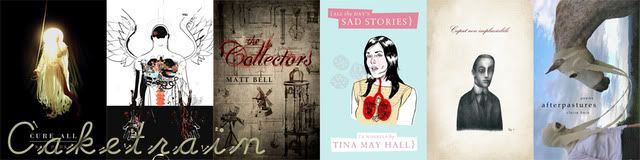
An Interview with Caketrain Journal & Press

Here's our second installment in the Small Press series. Check out our past interview with Graywolf here.


What makes your press different from other publishers?

The small press world is so large and various that there is surely no single characteristic that is completely unique to Caketrain, but that being said, there are a few qualities that we’ve labored to cultivate.

We strive to release interesting and daring work to an audience at an affordable cost and to give attention to writers who may be overlooked by larger publishing houses. We aim for a vision that is at once distinctive and anonymous. Each Caketrain chapbook and each work in an issue of the journal is chosen to establish a thematic and aesthetic telephony with the others, a sort of collective concentration established primarily at the level of language in assembly. We’ve always been preoccupied first with the way a story or poem looks and sounds, and only secondarily with what it (literally) means, and we strive for this to come through in every book we release. But at the same time, if you’re properly engaged as a reader, we as editors, with our wants and wills, should be the last thing on your mind. If we’ve done our job, we should disappear from view. In the past several years, our visual identity has slowly ghosted away to the point where neither the cover of our journal nor the landing page of our website makes any prominent display of the word Caketrain—which, reflecting upon it now, seems all of a piece with this notion.

We take great care in the design and typesetting of our books: these characteristics, too often dismissed as superficial or inconsequential, can bring so much to bear, for good or ill, upon a text—and we recognize this and try to operate accordingly.

For seven years now we’ve held our price steady at $8 per copy, with free domestic shipping, so that anyone who wants to can affordably own a Caketrain book.

Because we are a two-person staff—a married couple working on the project in our home office—Caketrain is a part of our lives every day. Every correspondence you have with Caketrain, no matter how small, is an engagement with one of the only two people who make every editorial decision for the press, and with this in mind, we aim to be inviting, polite, kind and encouraging in all our interactions. We’ve actually been commended on the cordial nature of our rejections, and this is important to us—as editors, our work necessarily entails having to say no, often and unconditionally, and the best of efforts, in our estimation, is to shape a “no” into the sweetest epistle. We want everyone to walk away knowing that it means the world to us to have had the chance to consider them.

What’s a recent book you’re excited about?

There’s so much to be excited about right now. We’re releasing Cure All, a collection of linked fictions from Kim Parko, this month and we’re incredibly enthusiastic about that; Kim has always been, for us, one of those dream people who you start a small press with the hope of one day working with, and to have collaborated with her to bring her most complex, daring, accomplished work to life is an honor.

Recently, we’ve been engrossed in Scary, No Scary, by Zachary Schomburg; Envelope of Night, the massive collection of Michael Burkard’s earlier work; and In a Bear’s Eye, by Yannick Murphy.

Lydia Davis’s Collected Stories is easily the best investment of $20 the discerning reader can make this year.

In 2009, our annual chapbook competition yielded titles from Tina May Hall and Matt Bell, which proved very successful in limited-edition runs. In the fall of 2010, both chapbooks will return to print as part of full-length collections (Tina May Hall’s The Physics of Imaginary Objects from University of Pittsburgh Press and Matt Bell’s How They Were Found from Keyhole), which is very heartening news for us. These will both be must-read books, we have no doubt.

Also, one would do well to start following the work of Alec Niedenthal and Sarah Norek right away, voraciously, from journal to journal, and begin to envision the shapes their future collections may take.

What advice do you have for emerging writers looking to be published by a small press? What is it about a work that makes you want to publish it?

The efficacy of a carefully-researched submission, to a press that shares your vision of what writing can be and do, cannot be underestimated. To this day, we receive so many submissions which, regardless of their relative merits, are simply unfit for our mission. And while not everyone can afford to buy a sample from every press on the market, most small imprints are very generous with online excerpts. So we advise you to be well-versed: Do you enjoy and respect the other authors that the press has published? Does your writing approach the aesthetic of the press? Do you feel that your work can enhance the particular editorial vision of the press?

What prompted the founding of the press?

After completing our undergraduate degrees, we wanted to stay connected to the literary world and felt that starting Caketrain would fulfill our desire to be part of a support system for the literary community.

What is your relationship with small magazines/journals?

We see our fellow small presses, and hope they likewise see us, as friendly co-combatants. While we each try to carve out our own niche, and there is certainly a positive side to a competitive spirit, the real competition for small presses is not with one another, but with every other media engagement that might occupy a reader’s time. But books, when invested in, can reach out to an audience in ways that are unprecedented and unparalleled and completely personal—the very fact that a writer can touch a reader in that way is the thing we’re trying to champion; we want to connect writers to readers, plain and simple.

Wednesday, March 3, 2010

Goodbye to Barry Hannah

I remember reading Airships for the first time, shortly after college: that feeling of excitement you get when you read something you know is way smarter than you, followed by a little bit of sadness, knowing you may never write something quite so great. The line "I want to sleep in her uterus with my foot hanging out" from the story "Love Too Long" was pretty much the greatest thing I could imagine a guy thinking about a girl. I wanted my boyfriend at the time to think about my uterus like that.

Hannah wrote about messy people with quirky preoccupations, but no matter how grotesque or bizarre, he was always honest. An honesty that took your breath away, that made you want to be even more honest yourself. He'll make you laugh, too. If you haven't read him, do yourself a favor.

The remembrances flood the internet. Here's a few: The New York Times, Vanity Fair, The Rumpus.

Website of the Week - Cover Spy

The dictum says, "You can't tell a book by it's cover." CoverSpy, a blog on Tumblr, says that's a lie. The team is comprised of "publishing nerds" who swarm the streets of New York City to see exactly what people are reading. They check the subways, the streets, The Grey Dog’s Coffee on Carmine, some podiatrist’s waiting room, newsstands, parks, bars. If you're on the F Train and happen to be reading, you can't hide from these spectators. They'll call your book out, and your outfit.

While the posts border on a sort of distant stalker-type mentality (Did that sound nice enough? I'm not trying to make them sound creepy), it's a good source if you're in need of a new, popular read. If you're one of those people who browse aimlessly in Barnes & Noble, just looking for decent covers to pull you in to a new novel, this might save you some time. Or, if you frequent NYC and want to make an appearance on the blog, make sure to dress nice and smile while you're paging through chapters. Here's a recent observation: The Fortress of Solitude, Jonathan Lethem (F, 20s, blue boots & dove-gray jeans, looking v. serious, F train).

So start representing your books well, everyone. You never know who's on the lookout.
(Not creepy. Right?)

Tuesday, March 2, 2010

An Interview with Graywolf Press

It's Small Press Month at HFR!

Throughout March, we'll be showcasing interviews with some of our favorite independent presses. It's our way of celebrating the craft of publishing and their imperative contributions to bridge the writer to reader gap. Here's our first homage: to Graywolf. Enjoy!


What makes your press different from other publishers?

Graywolf Press occupies a unique place in the publishing world, as it is larger than many small presses, but still smaller (by far) than the larger New York houses. We feel that this allows us to publish work that we deeply care about from a range of authors, both emerging and established. Robert Boswell is an example of an established author that has left a bigger publisher to work with Graywolf, in part because of the attentiveness and thoroughness that are standard values here. At the same time, we are dedicated to publishing new voices, such as Tiphanie Yanique’s How to Escape a Leper Colony, which we will publish in March 2010.

We also pride ourselves on the attention we give to each book. Because we publish a limited number of books each year, all of them are given full editorial and marketing support. We believe that to truly publish a book, you can’t just print it and send it out, but that you need to nurture it, from start to finish. This can involve intense rounds of editorial work and revision on the author’s behalf, and marketing that is tailored to the book and its strengths. We’re also a nonprofit organization, which means that key funding comes from both individual donors and foundations.

What’s a recent book you’re excited about?

Well, the short answer is that we’re excited about all our books, or we wouldn’t publish them. That said, we’re particularly happy about Stephen Elliot’s The Adderall Diaries; Robert Boswell’s The Heyday of the Insensitive Bastards; and Percival Everett’s I Am Not Sidney Poitier, to name just a few titles we published in the past year. We are also thrilled that three of our books were named NBCC Award finalists this year: Notes from No Man’s Land, by Eula Biss; Close Calls with Nonsense, by Stephen Burt; and Chronic, by D. A. Powell.

What advice do you have for emerging writers looking to be published by a small press? What is it about a work that makes you want to publish it?

It’s important for writers to hone their craft, and seeking publication in literary magazines and journals is a good way to do that, as the act of submitting work drives you to revise and rewrite until, by the act of doing, you become a better writer. Familiarizing yourself with our list by reading Graywolf books is a great way to make sure you are sending your work to the right place. Professionalism—as evidenced by following submission guidelines, sending cover letters, and proofing your work for spelling and grammar errors before submitting—is a must if you want to be taken seriously. But no matter what publications or credentials you have, it all comes down to the work.

We’re always looking for singular, character-driven work that has an engaging voice and a sense of absolute authority. We aim to publish fiction, nonfiction, and poetry that you just can’t find anywhere else, whether because of its innovation, originality, or freshness of voice or form. We’re looking for writers whose work just grabs us and won’t let go. Again, you can get a great sense of what we’re looking for by reading some of our recently published books.

What prompted the founding of the press?

The press was founded in 1974 by Scott Walker in Port Townsend, Washington. He started out publishing letterpress editions of poetry. 35 years later, Graywolf Press has grown into an independent press that publishes fiction, nonfiction, and poetry.

It seems like with large publishers in financial straits, the small presses are getting more attention. So we ask: what has your press done to grow? Do you see further growth?

Our growth areas are tied in some ways to the downturn at larger publishers, though we certainly have our own successful goals and initiatives. Graywolf Press partners with a number of organizations in support of prizes such as the Cave Canem Poetry Prize, which supports the work of African American poets; the Robert Fagles Translation Prize, which supports poetry in translation; and recently, the Bread Loaf Writer’s Conference Bakeless prizes in fiction, nonfiction, and poetry. These partnerships allow us to expand the depth of our list by welcoming work that we might not otherwise find. Our editors also travel to international book fairs, such as the Frankfurt Book Fair, to seek out work in translation that might be right for the press. In addition we are actively soliciting work, reading widely, and building relationships with authors in a variety of ways. We expect continued growth, and will continue to foster relationships with authors who may at some point consider the plusses of working with Graywolf Press, rather than just the size of the advance tendered.

How big can a press be and still be considered small?

That’s a tricky question. With ten staff members and an output of about twenty-seven titles a year, we’re no longer a fly-by-night operation, but we consider ourselves a small press. Being a small press has as much to do with an aesthetic as it does size. Certainly being independent is crucial, as it allows you to take risks that larger, numbers-driven publishers won’t. Small presses have always aimed to give an outlet for work that big publishers won’t take a chance on, and today that is just as true. Poetry, story collections, and mid-list authors all get squeezed when they don’t sell, and that’s where we step in. A book can sell in smaller quantities than large publishers require and still be a success for us. In the end, regardless of size, if a press is doing the good work of producing literature that otherwise wouldn’t have a home then it should wear the small/independent press label proudly.

What is your relationship with small magazines/journals?

We subscribe to a number of literary magazines. All of our editors read widely in the hope of finding work that resonates with them. Often, an editor will ask to see more work from an author on the basis of work they have read in a magazine or journal. Though we don’t have particular ties to any organization, we feel that the work being done by literary magazines is an essential part of the publishing process. At the best journals, authors receive the chance to work with an editor before publication, though of course this isn’t true everywhere.