Come See our New Website

Thursday, November 26, 2009

Happy Thanksgiving!

Here in Arizona, the leaves aren't really changing colors in time for Thanksgiving weekend, so we're relying on a little bit of fiction to round out our pre-feasting experience. This story excerpt comes from Issue #33, back in 2004.

"The Leaves, They Pirouette"
by Kevin Grauke

When ladies at the church ask you what you do - what you are - you say, "I'm a leaf blower," and you're happy saying this. You're happy being a leaf blower.

[...]

When you're out working, you like to listen to a tape that your mother made for you for Christmas. You have to turn it up loud to hear it over your Echo. The songs don't have words, but you know what they're about because your mother told you their names. One is called "Autumn Leaves." One is called "Autumn in New York." One is called "Autumn Serenade." One is called "Falling Leaves." Your favorite, though. is just called "Autumn." It's just a piano. It sounds exactly like leaves would sound if they made music when they fell. Plink. Plink, plink.

You know that Autumn and Fall mean the same thing, but you like Autumn better than Fall. It makes leaves sound prettier. You wait all year for Autumn. Autumn is like Christmas except there's no Santa for Autumn. Dead leaves tumble and float with every gust of wind. The ground crunches beneath your feet, and the air smells like smoke. Autumn is better than Christmas.
*

Happy Thanksgiving, everyone!

Wednesday, November 25, 2009

News Around the Net

We've got a short one this week, because of the holiday. Enjoy!

Don't judge a book by its cover? The Guardian disagrees.

And if that's true, here are some books we should all read immediately. The best book covers of the decade.

Steve Almond, a contributor for The Rumpus (which we love), has self-published a book of writing tips and flash fiction. Here is an excerpt. It's good.

Here's a great, if not somewhat angry, review of the Raymond Carver biography by Stephen King. It starts with a recounting of Carver's drinking, then discusses his maybe fruitful, maybe poisonous, relationship with Gordon Lish.

Books of the year as told by nearly fifty novelists, poets, critics, artists, politicians and directors. Number of books listed by any of them which I have read? None. What do I blame? Cost of hardcover books. And laziness. I blame laziness too.

Philip Gourevitch is leaving the Paris Review. What do I have to do to get that job?

Why don't I have anything this valuable in my bathroom?

Tuesday, November 24, 2009

Twitterature is coming

In an attempt to break down the barrier between publishers and readers, bestselling author Rick Moody will publish his latest work via Twitter. The story will consist of 153 postings of 140 characters and will be put up every ten minutes from 10:00 am to 6:30 pm starting on November 30th and running until December 2nd. The literary journal Electric Literature is hosting what it calls "a grassroots exercise in participatory epublishing. Check out their Twitter feed here.

And yes, the story has been written specifically to be posted on Twitter, so we will not have any posts being cut off the in the middle of a word or anything lame like that.The idea is to tweet and retweet the story to followers and encourage them to do the same, helping literature reach a place it has never been before and attract new, more wide ranging audiences.

It's a clever idea, if not a little silly. But it's still a chance to read some new work by an extremely talented writer and respect the painstaking work it must have taken to write an entire story so it can be understood in 140 character bursts, as well as a chance to see how this whole thing turns out.

Thanks For Giving Me Something to Write About (The Workshop)!

“Thanksgiving; a holiday about generosity, love and colonization is a good indicator of how a family will interact while in captivity. I mean, proximity.”
–Anonymous Thanksgiving Survivor

This workshop is for anyone who quietly sneaks away from Thanksgiving dinner, into a nearby bathroom, and calls a friend just to be reassured that YOU are sane, but your family is insane. The holidays are rife with all the elements we need to write a great story: family, proximity, alcohol, conflict, resolution, dry turkey, and rich conversations! Why fight the holidays, when we can embrace them and cook up a great essay/play/book? What we will focus on in this writing workshop:

• Finding humor and absurdity in the whole notion of Holiday Cheer.
• Accessing memories of holidays past to connect thematically to holidays present.
• Generating new writing that will inspire and enhance old writing.
• Peer feedback.
• Learning how to escape the holiday madness by becoming a contemporary literary archeologist.

This workshop is designed to benefit ALL levels of creative writers in ALL genres!
Date: Saturday, December 19th, 2009
Time: 9:00am – 12:30pm
Place: Phoenix (40th Street and McDowell)
Fee: $50 (Please bring a writing utensil and paper.)

For more information please contact Tania Katan at info@taniakatan.com or 213.820.2606

About Tania Katan: Tania Katan is an author, playwright and performer. Her memoir My One-Night Stand With Cancer is the winner of the 2006 Judy Grahn Award in Nonfiction, an honoree of the 2006 American Library Association’s Stonewall Book Award in Non-Fiction, and a finalist for the 2006 Lambda Literary Award. Rock-n-Roller Melissa Etheridge said of Tania’s memoir, “This book rocks! It’s passionate, playful, and downright beautiful,” and the Library Journal gave the book a Star Review. Since the success of her first book, Tania has been performing her one-woman show, Saving Tania’s Privates (adapted from My One Night Stand With Cancer), which made its European premiere at the Edinburgh Fringe Festival in August 2008 where it was a critical success! In the U.S. Saving Tania’s Privates has been seen at such prestigious venues as ACT in Seattle and The Painted Bride Art Center in Philadelphia. Katan is a regular contributor to The Advocate, Compete Magazine, Stand Up To Cancer’s online magazine, and others. And because of her unique ability to write and perform she has become a regular performer at the Comedy Central Stage with Sit-n-Spin. For more information on upcoming workshops and readings please visit: www.taniakatan.com or www.twolittlewishbones.com

Monday, November 23, 2009

Residency & Fellowship

The HUB-BUB residency, based out of Spartanburg, South Carolina, is an 11-month opportunity for emerging young visual artists and creative writers between the ages of 20 and 35; the program allows three visual artists and one writer to "live free and create" for a year while working for a grassroots community arts movement. Residents receive a beautiful, rent-free apartment and bi-monthly stipend in exchange for 10-20 hours/week work for the program. The writer is given ample time to create, the opportunity to interact with other creative people, and a community eager and willing to support his or her work. To learn more about the HUB-BUB Artists-in-Residence Program and to download an application, please visit the website. The application deadline is February 15, 2010 with the next residency beginning June 15, 2010 and ending May 15, 2011. To see AiR live/work spaces, visit here. For any questions or to learn more, feel free to contact: Alix Refshauge/ AiR Program Coordinator/ 864.582.0056 ext. 3.

For the last forty years, the Fine Arts Work Center in Provincetown, MA, has run the largest and longest residency Fellowship in the United States for emerging visual artists and writers. Artists who have not had significant recognition for their work and writers who have not yet published a book with significant distribution are welcome to apply. Fellows receive a seven month stay (October 1-May 1) at the Work Center and a $650 monthly stipend. Fellows do not pay or work in exchange for their fellowships in any way. Fellows are chosen based on the strength and promise of their work. Former Visual Arts Fellows include Ellen Gallagher, Jack Pierson, Lisa Yuskavage, Angela Dufresne, Geoffrey Chadsey, and Lamar Peterson. Former Writing Fellows have won every major national award in writing including the National Book Award and six Pulitzer Prizes. The list of former Fellows includes Denis Johnson, Louise Glück, Jhumpa Lahiri, and Yusef Komunyakaa. The postmark deadline for the 2010-11 Writing Fellowships is December 1, 2009. 2010-2011 Visual Arts Fellowship applicants may apply online beginning December 1, 2009. Online submissions must be received by midnight February 1, 2010. FAWC will accept slide applications for one more year. Applicants submitting slides, must have their applications postmarked by February 1, 2010. For details, please visit the website.

Friday, November 20, 2009

News Around the Net

The National Book Awards were announced yesterday. Winning the award for fiction was Colum McCann for Let the World Spin. Among other winners were Ken Waldrop (for poetry), T.J. Stiles (for nonfiction), and Dave Eggers, winning the Literarian Award for Outstanding Service to the American Literary Community. And that's seriously an award. They aren't just making it up to give Dave Eggers another award, at least I don't think they are. And here's a play-by-play of the awards ceremony.

Philip Roth may have come up short on the Nobel Prize, but he's nominated for the Literary Review's Bad Sex in Fiction Award. So he has that going for him, which is nice.

Men only read biographies of athletes? Yeah, well women only read books by Jane Austen! So take that! I guess if we're going to be insulted by anyone as a gender, it might as well be Oprah.

The Guardian is taking a trip down Memory Lane. What were your favorite books of 2000? 2001?

Why are so many people writing books these days, Nathan Bransford asks. If more people are writing, that means more people are writing about sex or fishing (I see a lot about these two topics while reading HFR submissions). Or sex and fishing. Or sex while fishing. Oh dear God no...

Thursday, November 19, 2009

Jobs!

Gilman School, an independent boys’ school in Baltimore, announces its search to award the fifteenth Tickner Writing Fellowship to a writer in fiction, poetry, playwriting, or creative non-fiction. Responsibilities include teaching one senior elective in creative writing each semester, organizing a series of readings, advising the literary magazine, & working one-to-one with students in the Tickner Writing Center. Salary: $30,000, plus full benefits package. To apply: Send CV, cover letter, three confidential letters of recommendation, & a writing sample consisting of either 10 published poems or up to 30 pages of published prose to: Mr. Patrick Hastings, Director of the Tickner Writing Center, Gilman School, 5407 Roland Avenue, Baltimore, MD 21210. Firm deadline for receipt of all materials is January 8, 2010.

Saginaw Valley State University. The Department of English at Saginaw Valley State University is seeking applicants for a tenure-track Assistant Professor of English, with emphasis in creative writing: poetry, beginning Fall 2010. Required qualifications: PhD in English or closely related field; significant juried poetry publications; ability to teach introductory & upper-division creative writing courses & general education literature courses; commitment to department, university, & community service in the arts, including working with SVSU's visiting writers series. Preferred qualifications: Ability to teach multicultural and/or world literatures. Additional Information: 4-4 load. For further information & to apply for this position please visit www.jobs.svsu.edu AA/EOE.

Cornell University. The Creative Writing Program of the English Department invites applications for a poet (with an MFA degree in Creative Writing & at least one full-length book of poetry published by a reputable press) for a full-time, tenure-track assistant professorship beginning July 2010. The position involves teaching creative writing at the undergraduate & graduate level, teaching composition, perhaps teaching an occasional literature course, & assisting with program administration. Please submit a letter of application, curriculum vitae, dossier of recommendation letters, & a book of your poems to: Creative Writing Search Committee, Department of English, 250 Goldwin Smith Hall, Cornell University, Ithaca, NY 14853-3201. Deadline: December 15. AA/EOE

The Department of English and Creative Writing at the State University of New York at Oswego invites applications for a tenure track Assistant Professor position. Review Date: Review of applications will begin January 4, 2010 and will continue until the position is filled. Salary: Commensurate with rank and experience. Date of Appointment: August 2010. Description of Responsibilities: Teach Creative Nonfiction to a diverse population of undergraduate students as part of a vibrant, multi-genre creative writing program. Maintain a significant publication record. Required Qualifications: MFA in creative writing, with significant publication history and an interest in working with students from a variety of cultures. Preferred Qualifications: Teaching experience that promotes global perspectives and awareness at the undergraduate level. To Apply: Submit a letter of application, curriculum vitae, a copy of transcripts, three current letters of reference, and 10 - 15 pages of published creative nonfiction electronically to:
http://oswego.interviewexchange.com/candapply.jsp?JOBID=15980

Stanford University. The Department of English & the Creative Writing Program are conducting a search for a fiction writer at the tenured associate level. The successful candidate will have a record of distinguished publication, including at least one book, & a strong teaching commitment; he or she will be expected to teach courses at both the graduate & undergraduate levels in both the English Department & the Creative Writing Program & to hold a degree of practice (MFA, PhD, MA in Creative Writing) or the equivalent. Applicants should send curriculum vitae with a full list of publications & names & addresses of three references to: Professor Eavan Boland, Director, Program in Creative Writing, Stanford University, Stanford, CA 94305-2087. For full consideration, materials must be received by December 4. The term of appointment would begin September 1, 2010.

University of North Carolina Greensboro. Assistant Professor, Poetry. Tenure-track appointment in creative writing (poetry) effective August 1, 2010. Applicants must have published a minimum of one book & have appropriate teaching & professional credentials. MFA is the preferred degree. Candidates should possess the ability to teach creative writing & literature at both the undergraduate & graduate levels. The University of North Carolina at Greensboro, home to one of the oldest MFA writing programs in the country, is especially proud of the diversity of its student body & we seek to attract an equally diverse applicant pool for this position. Send letter of application & c.v. to: Chair, Poetry Search Committee, 3302 MHRA Building, UNCG, Greensboro, N.C. 27412. Dossiers will be requested after initial screening. Include SASE for acknowledgment. Postmark deadline is November 20. AA/EOE.

Wednesday, November 18, 2009

Fellowship

The Reginald S. Tickner Writing Fellowship is an annual writer-in-residence position named in honor of Reginald Tickner, whose 41-year career at Gilman impacted thousands of Gilman students. Each year, the Tickner Fellow: Directs the Writers at Work Series, a yearly program of bringing writers to campus to give a reading and work with classes for a day. Advises Paragon, the school’s award-winning literary magazine, published at least twice each year. Teaches one section of Creative Writing to seniors every other day in addition to leading occasional creative writing projects in other English classes. Consults one-to-one with students on their writing as part of the Tickner Writing Center and inindependent study. Uses his/her non-teaching day for activity related to personal writing projects and shares the process with students and faculty. The Reginald S. Tickner Writing Fellowship is a one-year, 32-hour per week position. The salary is approximately $30,000; full benefits package available. Interested applicants should send resume, cover letter, threeconfidential letters of recommendation, and samples of published writing to: Patrick Hastings / Director of the Tickner Writing Center / Gilman School /5407 Roland Avenue / Baltimore, MD 21210. Materials must be RECEIVED by and NO LATER THAN January 8.

Ask the Archives: Writers Sum Up the Joys and Lamentations of Writing

It would appear that even prolific writers of longtime standing and regard in the craft sometimes find themselves lost in their work, wondering how good it is, if it is, and why they put themselves through such grief. They seem to encounter their own unique Rodney Dangerfield moments whereby they feel they don’t get no respect, no respect at all. Yet for all their angst and struggle, they vindicate their efforts with the consolations found inherently within the work itself, the act of writing. Here's what some writers in the HFR interview archives had to say about that. (For more Ask the Archives topics, click here. To submit a question or topic to send us digging for an answer, email HFR@asu.edu)

JOSEPH HELLER (1986)
A chore? I write novels because novels are my choice. It’s stimulating: that’s what I want to do. But it’s hard, it’s irritating, it makes you unpleasant, it makes it hard to be with people and hard for people to be with you…But I write novels because I want to. I mean, I think people can enjoy their work and still take their work seriously. But they can only take it seriously if it isn’t easy.

JOHN ASHBERRY (1993)
I like writing poetry, but there are times when I would much rather watch television than read poetry, so I sympathize with this situation. Certainly no one is obliged to read my poetry or any poetry, but there are people and moments when this is an important pleasure.

VIVIAN GORNICK (1993)
The point is, writing with ease and the goodness of the work is unexpected. Every now and then there’s a work of genius for no reason you can figure out; everything comes together, everything somehow magically comes together. A freeing up in the inner being, a subject that’s surefire, a piece of experience, for some reason, some mysterious reason, the writer stands right in the middle of that experience and can see all around it. Otherwise you’re hacking your way trough a jungle all the goddamned time to figure out what the hell you’re writing.

LINDA GREGG (2000)
And there is also the whole issue of communication and writing as a gift. Yet it’s like a realm. It is not just me trying to write a poem, it’s the things that come into the poems, visible and invisible. All the things that matter get to be part of the poems. It’s the thing that I have even though everything else is taken away…

JOHN UPDIKE (1988)
I don’t want to harp on the economics of it all, but I do think it’s harder now to take writing seriously. When I went to college, Eliot was firmly on his throne; one had no need to defend writing as something worth doing. Now I think anyone who sets out to write must at some point wonder if it is really not sort of a dying little dead-end. The Gutenbergian age is in its twilight: why should I be doing this for an American audience which basically doesn’t read anymore, juts flicks on the tube or whatever else it does—goes out and has a beer?
…So I guess I’m still reading fiction in hope of finding things there, news about life, news about what it’s like to be alive in a certain place.

ROBERT HASS (1997)
The one thing about writing, therefore, is that you are always coming up against the limitations of your own habits…
…I don’t know if art is escape, but work is escape and essential activity in life, really, and so I love having something long to work on because you go to your desk knowing that you’ve got this deep absorbing task to do. It is tremendously frustrating at times, but having the space to work out a complex subject fills up many days, and that is the wonderful thing about it.
…Do it! If you want to write, write!

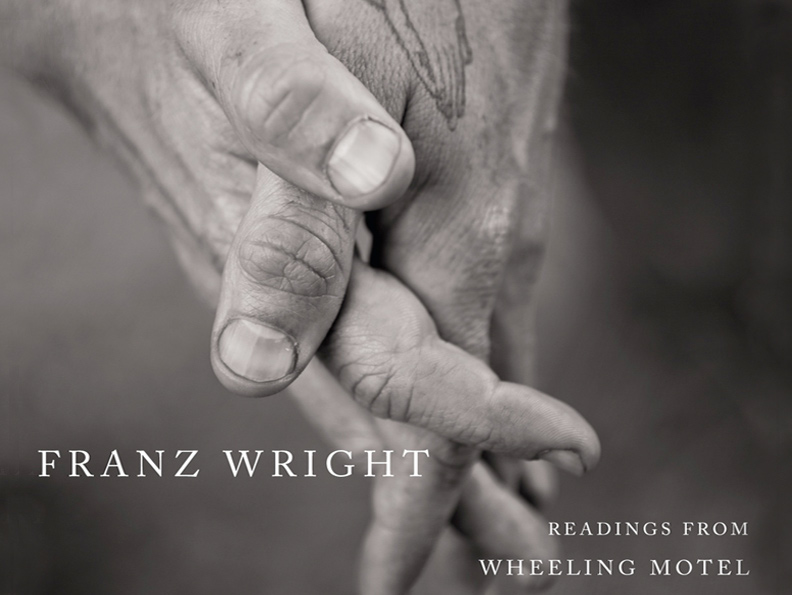
Readings from Wheeling Motel

Pulitzer Prize-winning poet Franz Wright recently collaborated with Los Angeles musicians/producers Daniel Ahearn (Ill Lit) and Michael Rozon (Brazzaville, Melvins) to produce Readings from Wheeling Motel, a musical exploration of the poet's new work. The New York Times Book Review has already praised Wheeling Motel, Wright’s tenth collection of poetry, as "uningratiating, bumptiously witty...and routinely surprising," and this marriage of Wright’s poetry and Ahearn and Rozon’s music is sure to cross the boundaries of literature and music and appeal to fans of both.
Wright himself recites the selection of poems amidst the original music Ahearn and Rozon produced in collaboration with six other musicians: Josh Grange, Michael Whitmore, Eric Wood, Mindy Gaspar, Aaron Embry, and David J. Don’t expect violin crescendos or bongos playing in the background here; the music, directly inspired by the poetry itself, serves as a dreamy counterpoint to Wright’s distinctively husky voice. This project demonstrates Wright’s status not only as an artist but also as an inspiration, offering us an opportunity to experience this world-class poet in a uniquely personal and direct manner.
You can listen to “Wheeling Motel” and “Day One,” here or watch this Youtube clip of Wright reading “Night Flight Turbulence,” all of which are featured on the Readings from Wheeling Motel record. Wright’s recitations were all recorded in his home, as the Youtube video shows. I, for one, was intrigued by his flowered wallpaper and the CDs, papers, and books spread in disarray on his carpet.
Readings from Wheeling Motel has been released in digital form only and is available now through iTunes, Amazon and Bandcamp.

Tuesday, November 17, 2009

Endangered Species Take 2

While the forthcoming Issue 45 will feature an excellent selection of poems translated from endangered/dying languages, John McWhorter in World Affairs Journal, questions the value in trying to save languages at all. McWhorter argues,
What makes the potential death of a language all the more emotionally charged is the belief that if a language dies, a cultural worldview will die with it. But this idea is fragile. Certainly language is a key aspect of what distinguishes one group from another. However, a language itself does not correspond to the particulars of a culture but to a faceless process that creates new languages as the result of geographical separation.
And later that,
The main loss when a language dies is not cultural but aesthetic.
But as poetry suggests, language is always more than what it presents itself as--and so a language that disappears takes with it more than the particular sounds and geographic markings of a specific ethnic group. It takes with it a key to unlocking ideas embedded within culture, not created from, but understandable through, language.

Though perhaps the best response to this argument can be found by reading the poets and translators working within these endangered languages. Another reason to check out Issue #45.

-Brian Diamond
International Editor

A Cup of Ambition: The Ghostwriter

We've all heard it before, at dinner parties, from relatives, from our therapists: "Oh, you write. Does that mean you'll be a teacher?" Fine, fine. We can't make enough money to "eat" or "live" from our poetry. Every MFA graduate knows the horrible feeling that settles into his/her stomach as graduation approaches. You finished a whole book!, you keep telling people. And still, no prospective employers come a-calling. Here at HFR, we know how you feel. We thought it might be interesting to take a closer look at some jobs we writers and lovers of books might enjoy. Or do enjoy. Or have tried, and regret. This regular post, A Cup of Ambition, will talk to those in-the-know about what the working world is really like. (To see our previous interviewees, click here.)

It’s our thirteenth Cup of Ambition, and we’re gonna give you a little salt in your sugar with ghostwriter Neil Strauss, who has co-written the autobiographies of rock stars, a porn star and journalist Joel Stein (who fell into neither category, although he did rock a mullet once). 

Strauss is also an American author, pickup artist and journalist.

It’s hard not to get lost in his feverish speech and profound observations thrown out as casually as the “you know?” he use
s to punctuate most sentences, but it’s impossible to miss 
how much he loves what he does and how far he had to come from his days as a discarded-popcorn scavenger at theaters, which I’m actually only assuming he stopped doing.

Getting started
Twelve years ago Strauss was assigned to interview singer Marilyn Manson for Rolling Stone magazine. Initially, he said, he planned to write an expose about who he assumed to be “some goth rock, phony poser.” However, it became a cover story about the time he spent with a “smart and really interesting” artist. The next year, Manson’s autobiography, The Long Hard Road Out of Hell, ghostwritten by Strauss, was released.

“I never intended to be a ghostwriter,” Strauss said. “I just thought ‘wow, this is a great way to write a book.’”

Having an open mind, he said, reflecting on Manson, is the most important thing about conducting an interview and working as a ghostwriter.

“There’s nothing wrong with going into an interview with preconceptions,” he said. “But you’ve got to be able to throw away those preconceptions in the face of reality. Some people go into an interview trying to prove a point and don’t really care what reality is. You’ve got to let the person be themselves, that’s the point of an interview.”

Before he was even a journalist though, Strauss said he was writing for free for anyone who would take his work (he sent his first book proposal, hand-written, to agents when he was 11 years old).

“I’ve been working on an anthology of my work, and I was looking through all these letters I wrote and seeing all of these rejections…I would do anything just to be around a magazine, to get their coffee, to do their expenses, to do Xeroxes. I would do anything. I had no money. I, literally, would, like, eat discarded popcorn in movies in New York because I had no money for food so I would spend it on movies and culture because I knew it would inform what I was writing…I was so naïve….and it’s fine, we’re built to survive, we’re gonna survive. You’re not gonna die, you’ll find a way to make it happen, you know? So you’ve got to keep doing what you love and not expect to, right away, be writing for some huge magazine or write some huge book, just be willing to write for free for anyone who will have you write. In the meantime, it’s only going to help your craft and get your name out there.”

The Good, The Bad
A lot of things like making a film or cooking, Strauss said, are group efforts between people, but writing is just a relationship between the writer’s head and the page.

“I don’t think of it as a good side and a bad side…I don’t think of it like that. I think it’s a lot of fucking work. Literally, you know, it’s like sitting down and writing 400 or 500 pages on your computer is a hard thing, but the more difficult thing is taking those 500 pages and then making them work. Really tightening them and tightening them and tightening them until everything works…Making sure there’s no repetition in the 500 pages, making sure the story’s moving forward, being willing to take that story you spent a week crafting and just cut it out because it doesn’t work. So, that intense connection you have with 500 pages that only you wrote and only you understand and sort of cleaning and juggling it until it actually becomes a reasonable book is an intensely isolated and time consuming experience.”

And by time consuming, he meant that in the last month he’s worked 16- to 20-hour days. His Mondays alone, he said, are dedicated to “back-to-back” interviews and meetings.

“And every time, I’ll keep telling myself ‘I’m never writing another book again.’ I’m thinking, ‘why do I do this?’”

The morbid motivation
“I’m always thinking about what’s next, but what I’m most proud of is what I’m currently doing. I have four to five books under contract. They’re like a pack of wild dogs chasing me, so I don’t have time to look back or I’ll get eaten alive,” he says with an unsettling laugh. “I know it sounds like an exaggeration, but what motivates me is trying to get all these books done, like, before I die. When I’m excited about a book that I’m writing I think, ‘Oh god, I hope I finish this before I die.’…you just make sure you can express yourself in the right way to everybody.”

HFR: So, is there a pre-written eulogy?

Strauss: “I suppose [my eulogy] may be in ‘Emergency’ somewhere, because that book is a lot about accepting our mortality.”


The key to ghostwriting
The key to ghostwriting is storytelling. And in Strauss’ case, the books he writes are not for fans of a particular person he writes about, but rather are for fans of the world that person represents.

“I try to write the stories for someone who has no interest in that person,” he said. “And then if I can make it interesting, that is the challenge.”

Making a story seem universal doesn’t mean it has to be existentially vague either.

“Fuck the big questions,” he said. “The art is storytelling. Some people want to warm up but if you look at your life, what’s the most interesting thing that happened? Don’t wind up, just throw the reader into a really compelling story that they’re gonna wanna read separate from who you are.”

What makes a good ghostwriter?
You have to be able to listen to editors, he said. Adding that it’s true as long as they’re good. It’s important to accept criticism and be able to determine if it’s right or wrong, he said.

“I think a good ghostwriter will take another person’s words or life and write how they would write if they could write. I think empathy and lack of ego would be a good skill with this,” he said.

The real story, he added, happens when the tape recorder isn’t running.

“The more you can immerse yourself in [the subject’s] world and serve a purpose in their world, the more you can really step into their shoes and see through their eyes.”

This is also good, he said, for getting to know the other “characters” in the subject’s life. Talk to those people and spend time with them so you can see the kinds of things they don’t tell you, he said.

Thoughts about this job for writers…advice
Strauss explained that a lot of people are encouraged to do something safe and sensible that will make money, but it can a sure way to unhappiness if it’s not something you love to do. If you follow your bliss, you can make a lot of money and if you lose that money you have nothing, he said.

“The secure way is really the insecure way,” he said, quoting Joseph Campbell.

“It’s a great way to learn about publishing to get a book out and yet, if I wanted to, not to have any responsibility for it,” he said, laughing. He has a clause in his contract that allows him to withdrawal his name from a book he ghostwrites if he’s unhappy with the final product.

Turning down proposals for books isn’t rare, either. While Strauss said it has little to do with how famous or not famous the person who wants to write a book is, there are just a lot of people who aren’t ready to tell their story.

“[Subjects] have to be willing to tell the truth and the whole truth and hold nothing back. If there’s something you’ve done in your life that’s a really bad thing, whether you’re
 embarrassed about people knowing or don’t want to tell them, then don’t do a book…you know, someone’s going to spend 400 pages in your world. If you’re holding back, then you’re robbing [the readers] of your experience…[Authors] can’t be afraid to make themselves look bad. We all have dark sides, we all have insecurities, we’ve all done bad things; you’ve got to show them and just trust that in the end it’ll paint a complete picture of you as who you are.”

“[Subjects are] pre-screened to make sure they’re cool with the kind of book I want to write, he said. “I want to make sure they wont be their own worst enemy.”

People start with the ending, and most of the time it starts with one person who someone has complicated feelings toward, he said. It’s important to know what’s interesting to readers versus what that person finds interesting, he said. He explained that out of 10 hours of tape on how his subject feels about one particular person, only 30 minutes may be worth using.

A bit of theory
With a degree in psychology from Vassar College, Strauss said he considers himself a social artist as well as a writer.

“I think you’re not doing your job if the other person isn’t learning about themselves,” he said. “When you put your life back to back, end to end, certain things emerge. And you’re probably going to recognize those things before they do, because it is their life. It’s really like a light bulb is going off over the person’s head. There’s a therapy to it, like a ghostwriter.”

Our boundary is truth as that person sees it, he said, you can’t do a book with someone who is self-diluted. They need a certain distance from themselves, he explained. For example, when Strauss did his work with Mötley Crüe, he took the same story from all four members, and each version was a little different.

On James Joyce
“It’s one of the reasons I write; I never knew you could do that much with words,” he said about Joyce’s “Ulysses, which he re-reads every three years.

Inspiration/How To
Strauss and fellow ghostwriter and journalist Anthony Bozza lead the HarperCollins subimprint Igniter, which gives talented unknowns a chance to work with the well-knowns on their autobiographies after some training with Strauss, who also said he edits pieces of their work from time to time.

In an Igniter cinderella story, an out-of-work computer programmer was paired up to write the autobiography of a supermodel, Strauss said. He added that an autobiography about Bozo the Clown is also in the works.

As for future ghostwritten projects by Strauss, who is working on one of his own books right now, his feet are ready to be in the shoes of former Louisiana Gov. Edmund Edwards, whom Strauss could only describe as a “charming crook.”

Monday, November 16, 2009

Family Day of Culture for the Holiday Season!

Arizona Consortium for the Arts and Peoria Home and Garden Expo Center present A Day of Culture for the Holiday Season. Performances by local groups and readings from the fall issue of The Blue Guitar magazine, including a dedication of the issue in memory of Scottsdale resident and World War II veteran Richard Colosimo. This event is FREE to attend; there will be a raffle and display of art works. Please come join us for a day of fun festivities and more surprises await you!!!

Date: Saturday, December 12, 2009
Time: 12 p.m. - 4 p.m.
Location: Peoria Home & Garden Expo Center
8606 W. Ludlow Dr., Suite E
Peoria, AZ 85381
623-487-3343

Cool Offer From Black Lawrence Press

For over two years Diane Goettel, Black Lawrence Press Executive Editor, has been giving lectures on how to get the attention of small and independent presses. One of the problems with lectures, however, is that they are only available to people within commuting distance. We are solving that problem by putting Diane’s advice into a weekly newsletter. You may already get emails from Black Lawrence Press about contests and recent publications. This will be an entirely separate newsletter that will go out only to those of you that subscribe.

The newsletter will include tips for novice, mid-career, and seasoned authors alike. It will have information on what editors look for in cover letters, how to choose which writing conferences to attend, and how to choose the right press for your book. The newsletter will also address frequently asked questions that come in from authors like yourself. Furthermore, it will include case studies of authors who have done things like making a name for themselves with a chapbook, changing genres mid-career, using a second language to deepen their understanding of their craft in English. To summarize, we are going to chock each newsletter full of what we think is the freshest, smartest, most exciting insider information about small and indy publishing and how to get published by small and indy presses.

Want to sign up? It will just cost you the price of one Black Lawrence Press title. The choice is yours. (And we’ve got some great chapbooks that are only $9.)

Here’s how to sign up:
1) Go to www.blacklawrencepress.com
2) Click on “Books”
3) Browse our selection of titles, pick one that sounds interesting, and purchase it through Paypal.
4) Forward your Paypal receipt (it should automatically show up in your email box once you make your purchase) to publishingtips@blacklawrencepress.com with “SUBSCRIBE” in the subject line. You will automatically be subscribed for one year of emails.

Our first newsletter will go out this week, so sign up soon!

Best,
Your Friends and Black Lawrence Press

Issue #45 Preview: Echolilia


While searching for artwork for issue #45, the other editors and I were throwing around ideas for possible themes. Though we didn't officially choose one, there was a small group of words that kept re-surfacing - memory, fleeting, and forgetting. While sifting through the sea of potential imagery, those words acted as a guide for me and, ultimately, as the glue binding our selections together.

One aspect of memory that I felt really had to be addressed in the forthcoming issue was that of childhood. Photographer Timothy Archibald's ongoing collaborative project with his young son, Echolilia, was precisely what I was looking for. These images strike me with a haunting familiarity – almost like distant memories hiding in the back of my own unconscious.

Archibald says of the project, "when my eldest son Elijah turned five we began making photographs in a collaborative manner in which he was the subject and we both acted as the directors. I was looking for clues in the objects and poses, looking for a way to understand what makes him tick. I imagine he is collaborating with the photography as a way to understand me. Echolilia is our document of this process."

Pick up a copy of issue #45 (should arrive today!) to see more of Timothy Archibald's work, as well as other works by Beth Dow, Hong Hao, and Mark Klett.

Friday, November 13, 2009

News Around the Net

The TripleQuick Fiction iPhone app. Because you knew they would get in on all this Kindle fun, except this one is more lame. Unless you're really into flash fiction.

Do you like your fictional dogs cute and cuddly or as Communist cat exterminators? We all know the answer. Hell, I even like my real dogs to be Communist cat killing machines.

If you're bored, and have read every book ever, you can take this absolutely impossible First World War literature quiz. But then again, maybe I'm just an idiot. I won't reveal exactly what I got, but I will say that I was able to receive the "Badge of Shame", so I didn't leave empty handed!

Do you ever wonder what it would be like if Frank Miller wrote Charlie Brown? No? I bet you do now though. Never fear. It's beautiful, except that it's not.

The best illustrated children's books of 2009. It's apparently never too early to teach children to try to be witches or to befriend lions.

A devastating short story of effort, desire and heartbreaking failure. The first truly "true" thing I've read in a long, long time.

Last week we had Kurt Vonnegut's redesigned covers. This week, we have Vladimir Nabokov. These are fun.

This is why every time a homeless guy asks for a dollar for his nonsense poetry, I jump at the opportunity. You never know when fire will leave only two copies and suddenly they're worth $25,000. Not that William Carlos Williams is the equivalent of a homeless guy or anything.

Thursday, November 12, 2009

Website of the Week: Lit Drift

I found this week's website, strangely enough, through a post on the Arizona State University Department of English Undergraduate site.  Yeah, I didn't know Blackboard posts could be so helpful, either.  (I kid, I kid.)

Lit Drift has only been up and running since March, but it is overflowing with literary goodies.  The site proclaims to be dedicated to the art & craft of storytelling in the 21st century; its name is "a nod to how traditional forms of storytelling are, well, drifting into forms wholly new and unexpected."  I know I'm new to this whole blogging thing, but seriously, this site has firmly cemented itself as my Number 2 Favorite Blog (Number 1 being, of course, this one).

The very first thing you see when you enter the site is the Lit Drift header.  Every week features a header with a doodle sent it by one of the readers.  This week's doodle features Romeo gazing up at Juliet on her balcony.  The accompanying poem is as follows:

Zombie Romeo

SEE how she leans
her cheek upon 
her hand! O, that 
I were a glove upon 
that hand. That I might reach inside her 
head and chew on 
her scrumptious BRAIN.

And that's just the beginning of the awesomeness that is Lit Drift.  There's a Daily Prompt to help get your creativity flowing, along with a daily Featured Story.  Every Friday is Free Book Friday, where you can get a totally, completely, 100% no-strings-attached FREE book each and every Friday.  I triple-dog dare you to see if you can find a better way to kick off the weekend than that (that does NOT involve alcohol).

What appeals to me about Lit Drift is that it goes for a fresh approach to storytelling.  You won't find your average "Tips and Tricks to Write a Better Story" here; instead, it's "Some Things the Average Schmoe Can Learn From Crappy Horror Movies," which acknowledges the craptasticness of flicks like The Blair Witch Project and I Know What You Did Last Summer while pointing out that they still have good narrative points, like pacing or character motivation, which in turn can help you write a compelling story.  Just like Darth Vader, there is an ounce of good somewhere down deep in the evil that is all those D-grade bloodbaths.

Do yourself a solid and check it out.

Best New Poets 2009


The University of Virginia Press has released their annual Best New Poets 2009, publishing 50 of the best poems from emerging writers of the year past in an anthology, this year edited by Kim Addonizio. We're very proud to say that several past contributors to Hayden's Ferry Review made it into the publication.

Congrats to Danielle Deulen, Katy Didden, Brian Leary, Joe Wilkins, Joshua Robbins and all the other poets who made the cut.

Poetry Reading at Scottscale Museum of Contemporary Art

The Scottsdale Museum of Contemporary Art (SMoCA) will be resurrecting its poetry series titled “Museum Heart” in honor of a special free December 3rd public reading at 6:30 p.m. in the galleries featuring two notable Arizona poets, Alberto Rios & Brian Diamond. Museum Heart Readings were coined for a poem by the same title written by Alberto Rios which was dedicated to SMoCA during the Museum’s grand opening in 1999. The readings are co-sponsored by the Creative Writing Program at Arizona State University.

Celebrated poet Alberto Rios reads selections from his new book, The Dangerous Shirt, and some pieces from his memoir, Capirotada. A recent finalist for the National Book Award, Rios is the author of ten books and chapbooks of poetry, including The Theater of Night—winner of the 2007 PEN/Beyond Margins Award—three collections of short stories, and a memoir about growing up on the border, Capirotada. Ríos is the recipient of numerous awards and his work is included in over 200 national and international literary anthologies. His work is regularly taught and translated, and has been adapted to dance and both classical and popular music. Ríos is a Regents’ Professor and the Katharine C. Turner Chair in English at Arizona State University.

Brian Diamond will also be reading work for this event. Diamond holds an MA in Creative Writing from California State Northridge and is an MFA candidate at Arizona State University, where he is international poetry editor for HFR. His work has previously appeared in such publications as Sycamore Review, The Los Angeles Review, 42 Opus, Redactions, and Oakbend Review. He is a one-time winner of the New Yorker cartoon contest and is currently working on translations of Yiddish poetry.

Wednesday, November 11, 2009

Unusual Calls for Submissions

What Makes You Stronger: Real Talk About Breast Cancer
We want your true stories about your journey, the journey of a loved one or your secondhand experience as caregiver or medical professional. We want the anger, the despair, the "Why me, Lord?" and the moment you realized, that despite the ravages to your body, the body of the loved one or the person in your professional care... you gained strength from the experience. Tell us about it, keep it real, nothing is taboo. The aim is to strengthen those who've just begun the journey, form a support community by mentorship, for those desiring it, prayer and daily inspirational thoughts, coping strategies for the pain, recipes that tempt the appetite and anything else that you wish to share. Guidelines: All essays/stories should be nonfiction narratives, written in the first-person. Focus on one or a few selected moments; do not send rants or political speeches. Essays/Stories should be titled. Essays/Stories should be between 100 – 650 words and poems restricted to 40 lines. No funky fonts, please. Please include a brief bio (1-3 sentences) at the end of your submission and forward a headshot (neck and shoulders) to dee(at)deeswhite.com or tramsey43(at)gmail.com (replace (at) with @). More here.

2010 Fiction Contest: Creative Loafing Atlanta
Submit a manuscript of no more than 3,000 words either as a hard copy to our offices or online. All works of fiction must in some way incorporate the word “slip” — as a theme, a metaphor, whatever. You can use the word as any way you like; just use it well. Originality is encouraged, and the word count is enforced. Deadline: November 20, 5 p.m. 1st place, $1,000. 2nd place, $250. 3rd place, $100. Winners will be published in Creative Loafing and honored at an awards ceremony. Submit story here.

Silver Boomer Books: Anthology Calls
A Pinch and a Dash - recipes from home and long ago. Silver Boomer Books seeks submissions for an anthology tentatively identified as A Pinch and a Dash - recipes from home and long ago. Submissions of prose and poetry should be submitted pursuant to these guidelines by January 15, 2010. The focus of the anthology is family or friendship memories associated with a particular meal or food. We're asking for the recipe as well as the poem or prose about it. You will be asserting you have the right to publish the recipe in your name. If it is copied from a cookbook, it doesn't work. If you use the same ingredients and describe the process differently, you have written an original work. The combination of ingredients cannot be copyrighted; the text somebody else wrote is. Send poetry or prose and recipe, and consider our earlier anthologies, Silver Boomers, Freckles to Wrinkles, and This Path for examples of style. More here.

2010 Chautauqua Fiction Contest
Prize: $1,000 and publication in Chautauqua, the literary journal of the Chautauqua Institution. Winner and finalists receive a copy of the journal. Theme of music and words broadly conceived. Submit short stories up to 5000 words. Entry fee: $20. Judge: David Crouse. Submissions will be accepted between August 1 and November 15 only. Submissions must be made using www.manuscripthub.com. More here.

Silk Road Review, a Literary Crossroads, invites submissions of poetry, fiction and nonfiction for upcoming issues. The magazine will celebrate its fifth year of production and expand to two print issues per year in 2010. This is a great time to submit your work to the magazine. We are interested in publishing compelling and finely crafted writing from locations around the world. We are also producing a special issue on “secret places” and welcome writing that would fit the topic. Silk Road takes submissions through our online submissions system. Visit Silk Road’s website for more information on the magazine and how to submit.

Daughter/Father Stories Call for Submissions
Seeking Female Writers to to share how your father’s character, personality, and/or actions (in-actions) influenced your development, for the opportunity to be included in an anthology to be published in June 2010. Deadline is December 15, 2009. No longer than 1200 words, your narrative should be emotionally moving and tangible with descriptive imagery readers can relate to via sight, sound, smell, touch and taste. Email daughterstory(at)gmail.com (replace (at) with @) your full name, address, daytime phone number, and e-mail address. Your story MUST be submitted as a .doc attachment, or in the body of the email, double-spaced in 12pt. font, Times New Roman. Any other format will not be read. In the subject line include your year of birth and a one-word theme for your narrative. Also include a bio—a short paragraph (of about 50
words or less) about you, promoting your latest book, project, etc. More here.

Tuesday, November 10, 2009

We're Hiring!

Assistant Professor in Creative Writing, with emphasis in Fiction or related discipline. Required: M.F.A. or Ph.D. in Creative Writing / Fiction; at least one published book of fiction; evidence of excellent and ongoing creative writing projects and of effective college-level creative writing teaching and student mentoring. Desired: Experience teaching graduate creative writing courses. Teaching load is normally 2/2 for tenure-track faculty with a significant creative writing agenda.

Application: Send a cover letter; c.v.; statement of approach to teaching undergraduate and graduate creative writing; list of creative writing courses taught; three letters of reference; and a writing sample (books will not be returned without SASE). Send application materials to: Chair, Creative Writing Search Committee, Department of English, Arizona State University, Tempe, AZ 85287-0302.

Application Deadline (no faxes or emails): Postmarked by November 16, 2009. If not filled, then every Monday thereafter until search is closed. A background check is required for employment. Arizona State University is an equal opportunity/affirmative action employer. Women and members of under-represented groups are encouraged to apply.

Issue #45 Preview: The Name of the Thing

I'm not one for titles. I appreciate witty ones but I usually find them to be functionally descriptive or useful as mere labels to distinguish one story from another. This probably apocryphal anecdote about Somerset Maugham's advice to a young writer about how to title his recently finished novel comes to mind:
"Does it have drums in it?"
"No, sir."
"Does it have bugles in it?"
"No, sir."
"Call it No Drums, No Bugles."
(I'm definitely using that title in the future so don't steal it.)

But the title to Matt Bell's story in Issue 45, "Dredge," struck me for a number of reasons. For one, it sounds like the word "dread," both of them rough Anglo-Saxon words, with "dredge" having the symmetry of soft "g" sounds bookending an almost guttural vowel. And both sound a bit like "dead." It's an appropriate association because, as the story progresses, one's sense of dread grows, not in the ominous Lovecraftian way (though the subject matter might incline one to think it) but in a way that simply suggests things will not turn out well by the time the story ends. The title, the deepening of a waterway by digging up the bottom, also works on an imagistic and metaphoric level: digging up the past, bringing suppressed emotions to the surface, piecing together a mystery from the bits and pieces found embedded in muck. Dredge, for me, also has a connotation of messy and methodical manual labor, which prefigures the way the main character, Punter, goes about his business.

Hopefully, I'm not giving too much away but "Dredge" sort of answers the question, "What if one of the fishermen in Carver's 'So Much Water, So Close to Home' was obsessive, unstable, and had brought the body home with him?" Here, Punter stores the body he finds at the beginning of the story (the imagery is fitting):
"In the garage, he lifts the lid of the chest freezer that sits against the far wall. He stares at the open space above the paper-wrapped bundles of venison, tries to guess if there's enough room, then stacks the meat on the floor, makes piles of burger and steak and sausage until he's sure. He goes out to the car and opens the back door. He lifts the girl, grunting as he gathers her into his arms like a child. He's not as strong as he used to be, and she's heavier than she looks, with all the water filling her lungs and stomach and intestinal tract. Even through her tank top he can see the way it bloats her belly like she's pregnant. He's careful with her as he lays her down in the freezer, careful as he brushes the hair out of her eyes again, as he holds her eyelids closed until he's sure they'll stay that way."
Matt Bell's writing is strange, in that good way which brings charm and mystery to a story. And it started from the very beginning with the title. There's plenty strangeness and charm in the same vein with the other stories in this issue. It was a real pleasure to include them. Hope you enjoy.

-Brian Lee
Prose Editor

Sunday, November 8, 2009

Issue #45 Preview: Wide Little Eyes

When people have children, and the children grow up and start doing impressive things, the parents swell with pride. The parents hang certificates and drawings up on their fridge, and gloat to aunts, uncles, neighbors and friends about their children’s various accomplishments and talents. People gather round to coo and clap. I have never had a child. I have, however, helped to edit the poetry in issue #45 of Hayden’s Ferry Review. I’m sure that this was not nearly as painful as childbirth (it was actually quite pleasurable). But I still feel entitled to some gloating and prideful chatter. So here goes: just look at her wide little eyes! What I mean to say: look at those sharp, stark, startling words.

The issue starts out with two poems by Joseph Mains. They are mysterious and fragmented, but sharp and chilling at the same time. These poems are a little like absinthe. I offer one of my favorite lines as a teaser: 'The sky is teflon and the stars slide from it.' The poems then travel from Mains’ semi-haunted interior landscape: “Your skin all wet & lace/ We either grow from each other/ or from ourselves we grow into one” to Korea, to Wal-Mart, to Karina Borowicz’s Moscow, to Sean Patrick Hill’s “Shotpouch Road” where he states “All I know is, everything here is a form of rain. Yellow arum, rain. Rotten hog fuel, rain…” Perhaps this is getting too serious, too rainy for you? I suggest turning to Mary Ruefle’s “Donkey On” for a bit of quizzical wisdom. Or take a look at Miles Fuller’s “Listening to the Night Club Gossip.”

The poems in this issue vary in location, substance, and demeanor. John W. Evans offers a heartbreaking and solid series of ghazals. The excerpt from Samuel Forsythe’s “Fugue State” is a litany of things to forget but contains many images which are unforgettable: “forget ages breathing/ stillness into whistles/ till they stop/ till lips stiffen/ and only listless/ hissing escapes.”

There are so many things I’m excited about in this issue. This blog post should not have taken me as long to write as it did, but every time I flipped through the pages the issue would start wriggling and show me something it could do that I’d never seen it do before. What can I say? I’m a proud parent, enthralled.

-Rose Swartz,
Poetry Editor

Friday, November 6, 2009

Issue #45 Preview: Endangered Species

Any linguist will tell you, language is not a static thing. Languages change, evolve, mutate, in a way similar to any living organism. Read Beowulf in its original Old English and this is clear.

But languages don’t just change. Sometimes, they disappear entirely. To a degree, this is natural and to be expected as a byproduct of natural selection, but when languages disappear, they don’t just take their vocabulary with them—they take entire cultures, histories, ideas. By some estimates, nearly half the languages spoken today will be lost within 100 years.

To the degree that poets are the keepers of language, it’s not surprising that they would find themselves drawn to the cause of endangered or otherwise forgotten languages. The act of translating a poem is more than just transferring a set of codes from one tongue to another, it is the art of attempting to resurrect what is lost, or otherwise hidden, by language. If Latin still lives, it is largely due to Catullus, Virgil, Propertius, and Ovid (and perhaps medical school, but that's another story).

In the upcoming issue of Hayden’s Ferry Review (issue #45, coming soon!), we will feature poets translating work from seemingly forgotten languages. Yiddish, Euskera, Isthmus Zapotec, and Ladino--languages with unique histories and cultures, but a common story—the story of what has been displaced, often by forces that have nothing to do with “natural selection.”

In these translations we see, not only good poetry (though it cannot be forgotten that the poems are very good), but the assertion of poetic language against the forces of history. The ways in which the poem makes present that which otherwise would be ignored.

-Brian Diamond
International Poetry Editor

To find out how to pre-order your copy of issue #45, due out next week, email HFR@asu.edu.

News Around the Net

The covers to Kurt Vonnegut novels are finally getting redesigned. Does this mean that someone finally realized that multiple books should not look exactly the freaking same?

The top 10 novels of sexual jealousy. You know it's good since every story ever is written about sexual jealousy (at least the ones I've been subjected to), so it's quite the pool to choose from.

Harvard Lampoon has released a satire of Twilight, called, creatively, Nightlight. It features Edwart Mullen, a computer nerd whom everyone believes is a vampire (but he isn't), and klutz Belle Goose, who believes every man in town is in love with her. Again, that is the description of the satire, not Twilight. It tricked me too.

Since no one had ever heard of her, nevermind read any of her work, here's a link to an excerpt to Herta Muller's novel Everything I Own I Carry With Me. It's in English and everything!

The shortlist for the Guardian First Book Award in 2009 have been named. Again, I feel sad because I haven't read any of them and have never heard of any of the authors. The winner will be announced in December. Hold your breath.

Stephen King in Playboy! Poetry, I mean. He wrote a poem which will appear in Playboy. I'm sorry, but there will be no pictorial of Stephen King under an exotic waterfall with a blonde, Norwegian centerfold.

Thomas Pynchon had a cold once. It was in 1973. You want proof? This creepy guy whose father was Pynchon's doctor has an x-ray of his chest from the visit. Seriously. He got a signed copy of Gravity's Rainbow out of it and everything. I guess being prying and creepy pays off.

This is so stupid already. No, fiction's day is not "done". How long have people been saying this? How long will they keep saying it? Does anyone actually believe it? Urgh. Just urgh all around.

Dave Eggers won the French literary prize for best foreign work of fiction, the Prix Medicis, for What Is the What. Personally, I can never forgive him for naming his first book A Heartbreaking Work of Staggering Genius. No, no, and no.

Speaking of Dave Eggers, here's the coolest, most colorful, most literary, most expensive newspaper ever!

Publisher's Weekly clearly doesn't like the ladies as much as I do: the skinny on their top-ten novels of the year controversy.

Thursday, November 5, 2009

Website of the Week: PoetrySpeaks.com

This is one of the cooler things I've seen in a while. I think the best way to describe it is as iTunes for poetry. The goal is to broaden the appeal of poetry and allow anyone to access and join the poetry community. You can even upload your own work onto the site in video or audio to help "find your audience" (a damn near impossible thing to do without help from some sort of medium). It can be your one stop shop to read poetry by the greats, the unknowns, and get yourself heard. There's even a blog in case you're tired and bored of this one (it's a joke, please don't leave us).

Fast, easy to navigate, and just a really great idea all-around. Check it out.

Wednesday, November 4, 2009

Calling All Creative Writing Teachers

You remember the moment. The moment when, instead of obsessing over it, dreading it, feeling all pedagogically anxious about it, you knew what exercise you were teaching in your next creative writing class. Maybe the idea dawned slowly over a week. Maybe it was an “A-ha moment,” conceived in a flash. But you were relieved. Finally, you said to yourself, I have figured out the perfect example for teaching the importance of dialogue (or setting, or transitions, or point-of-view, etc.). We’re glad that you did. Now we want you to share it.

Hayden’s Ferry Review is starting a new feature on this blog where we are collecting the best practices of writing teachers. We’re looking for your brainstorm, your cruise missile, your killer app. The exercise, writing prompt, lesson plan you wouldn't think of not doing. Share it with us and we will share it with the world. By putting these best practices out there, we’re hoping to strengthen the writing community as a whole, writers and teachers both. Submit your A-ha moment, then come back to us and read the other submissions to find out what other great teachers are doing.

See our fine first example below by BJ Hollars. And if you have your own, write to us at HFR@asu.edu and we'll consider posting it on the blog.

Tuesday, November 3, 2009

The Squid and The Whale And The Iceberg by B.J. Hollars

Hayden's Ferry Review is starting a new feature on our blog collecting the best (most interesting, most unusual, most helpful!) practices of creative writing teachers: assignments, exercises, demonstrations, speeches, prompts, lessons, etc. As recently as this year there was an article in The New Yorker titled "Show or Tell: Should Creative Writing Be Taught?" There is still the idea among some that creative writing is an ephemeral thing that cannot be explained. Or worse, that great writers are simply born, not improved through study and practice. Literally, it's time to get the word out about what we do and how well we do it. Good for writers, good for teachers. Our inaugural piece is below. We hope you enjoy it.

The Squid and The Whale And The Iceberg
by B.J. Hollars

It was not a stroke of genius, but perhaps, more a stroke of necessity.

I was having trouble teaching my creative writing students the art of subtext, and as I fuddled through all kinds of examples shouting, “See? Don’t you see what’s not there?” I eventually received enough side-long glances to understand that that answer was no; they did not see what was “not there.”

Nor should they have.

Charles Baxter’s The Art of Subtext does a far better job of teaching this skill than I, welcoming the writer into “the realm of what haunts the imagination: the implied, the half-visible, and the unspoken.”

Meanwhile, I remained confidant in my own unique approach, tearing out my hair while shouting, “See? You people need glasses or what?”

As it turned out, my students required no optometric assistance whatsoever, and the best way for my students to “see” subtext was to actually show them a visual example. Perhaps no visible example is as spot-on as the opening scene of Noah Baumbach’s 2005 film The Squid And The Whale.

For those unfamiliar with the movie, it’s the story of two boys who witness and play roles in their parents’ divorce. It’s pretty heart wrenching, to say the least, but what makes the film so powerful is the level at which Baumbach relies on subtext to tell the tale, leaving didacticism at the door.

In the opening scene, Bernard (the father) and his eldest son Walt engage in a doubles match against Joan (the mother) and Frank, the youngest son.

The scene is brutal.

While nearly every line of dialogue could quite easily find its way into any ordinary doubles match (“It was out” and “It’s my call” and “It’s part of the game, Mom”) the way in which the lines are delivered offers a staggeringly brutal account of a family in shambles. Baumbach never gives us any particular lines related to the impending divorce, yet the doubles teams clearly align who sides with whom, drawing battle lines prior to showing us the battle.

As a class, we watched the scene twice, the first time simply observing it, and the second time with excerpts from the screenplay in front of them. The students marveled at the dialogue, trying to find strategies that they could incorporate in their own work.

And yet…it wasn’t just the dialogue, but also, the circumstance, which allowed for such powerful subtext. We began discussing Hemingway’s “Iceberg Theory” in which he argues, “If a writer of prose knows enough about what he is writing about he may omit things that he knows and the reader, if the writer is writing truly enough, will have a feeling of those things as strongly as though the writer had stated them.”

Essentially, much like an iceberg (which is one-eighth above the waterline and seven-eighths below), if we tell it true enough, what remains below the water will always rise to the surface.

It seems an impossible trick, and yet the opening scene of The Squid And The Whale is proof. The viewer understands the entirety of the family dynamic by the way in which the characters position themselves and deliver their lines.

The doubles match was simply the vehicle to reveal what familial tragedies lingered just below the surface.

In one instance, after Bernard “accidently” hits Joan with a tennis ball, Walt cries out, “Yes!” while Bernard cries, “Joan! I’m sorry! It was an accident!” Joan walks off the court, and while Bernard chases after, the two boys are left alone. Walt stares at his bother disapprovingly—and without ever mentioning their parents’ behavior—informs him, “You got to get a second serve.”

The words are cold, and yet, in another context, under difference circumstances, they would just be part of the normal tennis-related conversation.

But we know better.

And the audience knows better.

And hopefully, the students know better now, too.

Monday, November 2, 2009

Jobs!

The Department of English at the University of Nevada, Las Vegas, is searching for a Fiction Writer, RANK OPEN. This is a full-time, 9-month, tenure-track position available fall 2010. Duties include teaching undergraduate and graduate courses and participating in screening applications for distinguished MFA program. Significant publication is expected. All applicants must possess a M.F.A. and/or Ph.D. in English from an accredited college or university with significant book publication. A secondary specialty in screenwriting, playwriting, or literary translation is preferred. Salary competitive with those at similarly situated institutions. Position is contingent upon funding. Online App. Form: https://hrsearch.unlv.edu

The Program in Creative Writing in the Department of English, University of Alabama, invites applications for a tenure-track Assistant Professor of English to teach creative non-fiction writing in our thriving MFA program and undergraduate creative writing minor. We seek a creative non-fiction writer with significant magazine publications and/or one or more published book(s), demonstrated excellence in teaching, and an appropriate graduate degree. The typical teaching load is 2/2, plus thesis supervision. All creative writing faculty members take turns directing the MFA program. In addition to undergraduate and graduate workshop courses, our faculty teach a wide variety of self-designed literature and/or creative writing classes investigating aspects of literary genre, history, and form. To get a sense of our rigorous and innovative curriculum, flexible approach to genre, faculty, graduates' accomplishments, and lively local culture, visit our website at www.as.ua.edu/english/08_cw/. Position begins 8/16/10. Send writing sample, transcripts, and three letters of recommendation to Prof. Michael Martone, Search Committee Chair, Assistant Professor (Creative Non-Fiction) Search, Department of English, The University of Alabama, Box 870244, Tuscaloosa, AL 35487-0244. Review of applications will begin OCTOBER 15, 2009, and continue until the position is filled.

The Program in Creative Writing in the Department of English, University of Alabama, invites applications for a tenure-track Assistant Professor of English to teach fiction writing in our thriving MFA program and undergraduate creative writing minor. We seek a fiction writer with significant magazine publications and/or one or more published book(s), demonstrated excellence in teaching, and an appropriate graduate degree. The typical teaching load is 2/2, plus thesis supervision. All creative writing faculty members take turns directing the MFA program. In addition to undergraduate and graduate workshop courses, our faculty teach a wide variety of self-designed literature and/or creative writing classes investigating aspects of literary genre, history, and form. To get a sense of our rigorous and innovative curriculum, flexible approach to genre, faculty, graduates' accomplishments, and lively local culture, visit our website at www.as.ua.edu/english/08_cw/. Position begins 8/16/10. Send writing sample, transcripts, and three letters of recommendation to Dr. Wendy Rawlings, Search Committee Chair, Assistant Professor (Fiction) Search, Department of English, The University of Alabama, Box 870244, Tuscaloosa, AL 35487-0244. Review of applications will begin OCTOBER 15, 2009, and continue until the position is filled. The University of Alabama is an Equal Opportunity/ Affirmative Action employer.

Rhodes College. The English Department at Rhodes College seeks a Fiction Writer to join the Department at the level of Assistant Professor (Tenure Track). We seek a published fiction writer, with specialties in American or other literatures, to teach a 2/3 load in our Creative Writing & Literature track within the English Department. We encourage applicants with an MFA &/or PhD in Creative Writing or Literature in hand or expected by August 2010. The candidate must demonstrate evidence of teaching excellence in both literature & creative writing, with the capacity to develop new courses in his or her areas of expertise. We seek a candidate with a strong record & potential for publication, who will join an academically rigorous department. Class sizes range from 15 to 25 students. Salary & benefits are competitive, with support for research & travel. Hardcopy Letter, c.v., & dossier containing three professional references by November 6 for MLA interviews to: Tina Barr, Chair, Search Committee, Department of English, Rhodes College, 2000 North Parkway, Memphis, TN 38112. Applications will be acknowledged electronically by support staff. EOE.

The English Department at St. Lawrence University invites applications for a one-year, visiting position in poetry. The successful candidate will teach both levels of our coursework in introductory and advanced poetry writing. Ability to offer coursework in early British literature is also desirable. Normal teaching load is three courses per semester. Ph.D. preferred. We encourage applications from candidates who bring diverse cultural, ethnic, theoretical, and national perspectives to bear on their writing and teaching. The successful candidate will join a department with a commitment to excellence in teaching, and to a program founded upon the essential relationship between creative expression and the study of literature. Please send a letter of application, a CV, and sample syllabi for two relevant courses to Poetry Search Committee, Department of English, St. Lawrence University, Canton, NY 13617. Review of Applications begins on November 15, 2009 and will continue until the position is filled. For more information, please visit the St. Lawrence University website at www.stlawu.edu.

The English Department of Eastern Michigan University invites applications for a tenure-track assistant professor position in Creative Writing. The Creative Writing Program includes undergraduate and MA studies emphasizing interdisciplinarity. We are seeking literary writers who work in more than one medium and/or take new approaches to genre: documentary poetics, text and image, performance, collaborative and community arts projects, digital arts and electronic media. Candidates must hold a graduate degree and demonstrate evidence of excellence in teaching, a significant publication record, and promise of continuing literary engagement. To apply for Posting # FA1027E, go to https://www.emujobs.com and click on the "View/Apply for Faculty and Administrative Positions" button located in the middle of the page. As a part of the application, all successful applicants will provide a dossier (cover letter, CV, three letters of reference, representative 30 page work sample and/or URL). Questions about this position may be sent to Dr. Christine Hume.

Assistant Professor of English-Creative Writing. Institution: Saginaw Valley State University. Location: University Center, MI. Category: Faculty - Liberal Arts - English and Literature. Posted: 10/16/2009. Application Due: Open Until Filled. Type: Full Time. Job Summary: Tenure-track appointment with emphasis in Creative Writing: Poetry. Minimum Qualifications: Ph.D. in English or closely related field; significant juried poetry publications; ability to teach introductory and upper-division creative writing courses and general education literature courses; commitment to department, university, and community service in the arts, including working with SVSU's visiting writers series. Preferred Qualifications: Ability to teach multicultural and/or world literatures.

The Writing Program in the School of the Arts announces several full-time positions as Lecturer in Discipline in its undergraduate Creative Writing Program with concentrations in fiction, poetry and creative nonfiction, effective July 1, 2010. The initial appointment will be for 1 year with the possibility of renewal for 2 more years. Salary is commensurate with experience. Review of applications will begin immediately, and continue until the position is filled. Full posting here.

HFR #45 Update

While a lot of you check in with us for our take on the latest word-related news flash, the biggest news for us this week is the upcoming launch of our new issue. After a serious bout of copyediting and a final loving gaze from the editorial staff, Issue #45 is off to the printer and will be making its way out to subscribers and bookstores soon after. Not a subscriber? We can fix that; send us an email at HFR@asu.edu. It's the best way to ensure that you don't miss out on a fantastic forthcoming issue. We'll be having the editors post next week on what their own favorites are, but my list includes the short story "The Fortune Seller" by Naveed Noori, a modern day Araby tale set in Iran; the great poem "Skew Lines" by Lilah Hegnauer, and an awesome wraparound cover by Chinese artist Hong Hao. Check out our last issue's content here if you need reminding just how great new writing can be, and then join us for the editor's posts next week as they whet your appetite for Issue #45.

Fellowship

University of Dayton. Herbert W. Martin Post-graduate Fellowship in Creative Writing, with possibility of renewal for a second year. Established in honor of the University of Dayton English Department’s longest serving poet & first African-American faculty member, the Herbert W. Martin Fellowship is designed to advance inclusive excellence & creative writing in the University & community. We invite applications from creative writers who demonstrate sustained personal engagement with communities that are under represented in the academy & who bring this asset to their teaching & scholarship. The fellow is expected to play an important role in the life of the Department during the term of appointment, & to contribute to our efforts to advance diversity & the arts. Responsibilities include teaching 2 courses per semester, including creative writing courses at the undergraduate & graduate levels, one course in a non-dominant or non-Western literature, & possibly one course in first-year composition; giving readings on campus & in the community; contributing to the Department’s biennial LitFest celebration; & serving on MA creative thesis committees. Required qualifications include MFA or PhD in Creative Writing within the past 2 years; a record of national & regional publication in at least one creative genre; ability to teach courses in at least two creative genres; & ability to teach one or more courses in non-dominant or non-Western literatures. Preferred qualifications include experience teaching creative writing at the undergraduate and/or graduate level; ability to teach drama writing; experience in community engagement; demonstrated commitment to advancing inclusive excellence in academic or community contexts; & interest & skills in writing for new media. Apply online at http://jobs.udayton.edu, with a letter of application, a one-page statement of teaching philosophy, & c.v.Review of applications will begin November 6, 2009 & continue until the position is filled. The University of Dayton, a comprehensive Catholic University founded by the Society of Mary (the Marianists) in 1850, is Ohio's largest independent university & one of the nation's ten largest Catholic universities. University of Dayton, English Department, 300 College Park, Dayton, OH 45469-1520. AA/EOE.